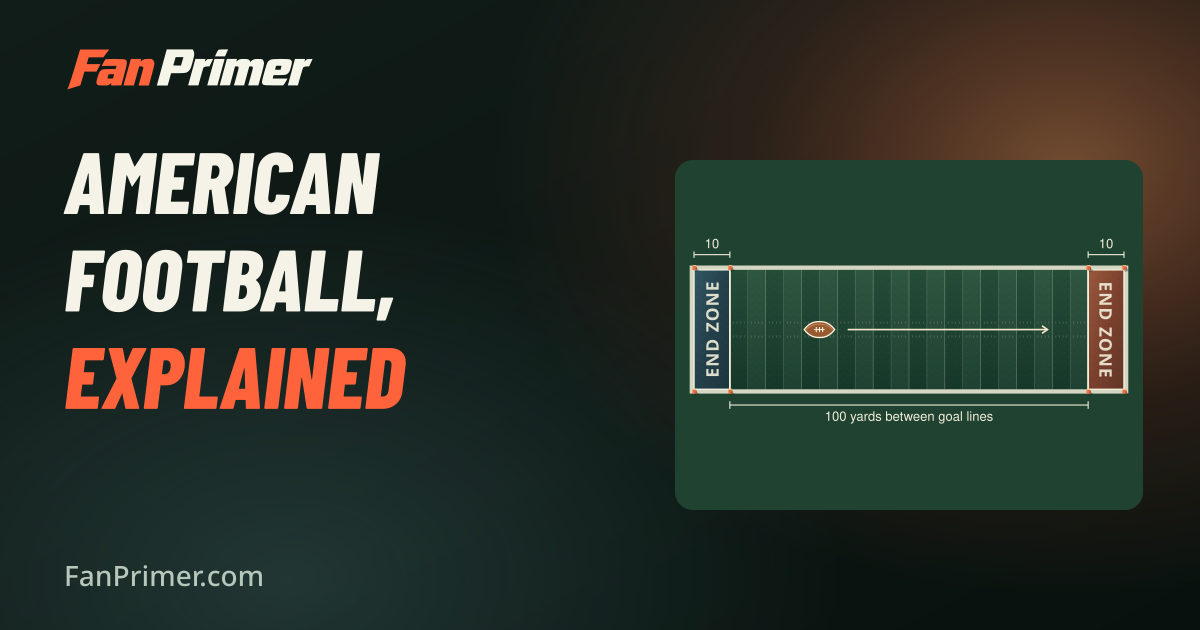
American football, explained
New to American football? Start with the field, the players and how teams score. Or find a clear answer to something you just saw in a game.
New to football? Start here
Learn what you are watching: where teams try to score, what players do, and why the next play changes.
6 chapters · About 5 minutes to browse
Start the beginner course →See the course chaptersFind an answer
How does American football work?The team with the ball tries to move toward the other team’s end zone and score. It earns more tries by gaining enough yards.→What are offense and defense?The offense has the ball and tries to score. The defense tries to stop it and win the ball. Both sides have 11 players.→What is the line of scrimmage?The line of scrimmage marks where a play starts. Find the ball before the play: that is where the starting line crosses the field.→What’s the difference between a run and a pass?On a run, a player carries the ball. On a pass, a player throws it. A successful catch can turn a short throw into a long gain.→What is a down?A down is one try to move the ball. The team normally gets up to 4 tries to reach its next target.→What do 2nd and 7 or 3rd and 7 mean in football?“3rd and 7” means the team is on its 3rd try and needs 7 more yards to earn 4 fresh tries.→How do downs and first downs work?The team has up to 4 tries to reach its target. Short gains leave that target in place; reaching it earns fresh tries and a new target.→What is a first down in football?A first down begins a new set of up to 4 tries. The team usually needs to gain 10 yards to earn another set.→Fourth down: go for it, punt or attempt a field goal?Fourth down is the team’s last try in a set. It can try to reach the target, kick for 3 points, or punt the ball farther away.→Why do teams punt in football?A punt usually gives the opponent the ball farther from your goal. Your team gives up another attacking chance to make the opponent’s next attack harder.→What is a turnover in football?A turnover suddenly gives the other team the ball. It can happen when a defender catches a pass or picks up a ball your team dropped.→How do teams score in American football?A touchdown earns 6 points, a field goal 3 and a safety 2. A separate attempt after a touchdown can add 1 or 2 more.→What is a touchdown?A touchdown scores 6 points. A runner already holding the ball can score by reaching the opponent’s goal line with the ball; his whole body need not cross.→False start vs. offside: what’s the difference?A false start is an illegal early offensive start. Ordinary defensive offside means a defender is across the starting boundary at the snap. Both usually cost 5 yards.→When does the NFL game clock stop and restart?An incomplete pass normally stops time until the next snap. A tackle inside usually leaves time running. Running out stops it, but the restart depends on timing.→How do defenders close running lanes?Defenders share responsibility for running lanes. One protects the outside while others cover openings inside, making it harder for the runner to escape.→What changes when a team accepts or declines a penalty?Declining usually keeps the play’s result. Accepting applies the penalty. Compare who gets the ball, where it goes and which try comes next—not just the yards.→Why can a pass travel farther than its air-yard number?Air yards count how far a catch is beyond where the play began. The throw itself can travel farther because the quarterback starts behind that line.→Can all four teams from one NFL division make the playoffs?Yes. One team can win the division, and its three rivals can take all three extra playoff places in their conference, called wild cards.→When is the ball out of bounds, and where is it spotted?Stepping on the sideline ends a run. Holding the ball over it does not always end the run. The ball’s position decides the credited yard line.→Who can recover and run with a blocked punt?Either team can pick up a blocked punt. Whether the kicking team can keep it or run with it depends on where it recovers and who touched it.→What changes about blocking after an interception or fumble recovery?After the other team wins the ball, neither side may block a grounded opponent below the waist unless he is the runner. Other blocking restrictions still apply.→What is the difference between blocking and tackling?Blocking gets in an opponent’s way. Tackling stops the player carrying the ball. A player without the ball cannot simply be grabbed and brought down.→What has to happen before different NFL bonuses are earned?A bonus is earned when its contract condition is met, such as signing or playing certain games. Earning money, receiving it and counting it against team limits differ.→What does the center do after snapping the ball?After sending the ball to the quarterback, the center must immediately block. On a pass, his job is to keep a rusher away from the quarterback.→Why does a player block briefly before running a route?A player can briefly bump a pass rusher to help a teammate block him, then run out for a pass. That brief help is called a chip.→Can an NFL team use deliberate penalties to run out the clock?A deliberate foul does not always waste time successfully. Officials can put time back, keep the clock stopped until the snap, or subtract illegally saved seconds.→Why are there extra compensatory picks in the NFL Draft?The NFL can add draft choices for qualifying free-agent losses or staff departures. These extra choices, called compensatory picks, make some rounds longer.→What does controlling your own NFL playoff fate actually mean?A team controls its playoff fate when winning all its remaining games guarantees the place it wants, whatever the other teams do.→Why does a runner step one way before running the other?A counter run starts with a misleading step one way, then goes the other. Blockers move across to open the runner's real path.→What do Cover 0, 1, 2, 3 and 4 mean?These coverage numbers describe help against deep passes: no helper, one helper, two halves, three thirds or four quarters. They do not count all 11 defenders.→What is the difference between a cut block and a chop block?A cut block starts below the waist. A chop block adds a teammate’s high block against the same defender. The high-low combination is illegal, and other low blocks face limits.→When is a receiver considered defenseless, and what contact is prohibited?A receiver still unable to protect himself gets extra protection from certain head, helmet and launching hits. Catching the ball does not instantly remove that protection.→Can the defense commit delay of game?Yes. Defenders can delay the next play by obstructing the restart or using a prohibited abrupt action near the line. Ordinary defensive delay costs 5 yards.→Can defensive holding happen on a running play?Yes. A defender can illegally restrain a player who does not have the ball on a run. No pass is required; ordinary defensive holding awards a fresh first down.→Can the defense score during an extra-point or 2-point attempt?Yes. The defense gets 2 points for returning a live extra-point attempt to the other end zone—even when the offense chose a 1-point kick.→What does deferring the opening coin toss actually change?Deferring saves the coin-toss winner's first choice for the second half. Simply choosing to kick now can let the opponent receive at the start of both halves.→What causes delay of game?The offense must start the next play before the play clock expires. Missing that deadline normally costs 5 yards without using a down.→Why might a punter aim toward the sideline?A punter can aim near a sideline to leave the returner less room. The chasing teammates must cover the same area for that plan to work.→Can defenders imitate the quarterback’s snap signals?The defense cannot use words or actions designed to confuse the offense at the snap. Officials stop play; this conduct rule carries 15 yards and an automatic first down.→Why can a runner travel 60 yards but gain only 20?Running sideways adds to the distance a player travels, but not to his gain. Yards gained measure how much closer the ball gets to the opponent’s goal.→Why can division and conference records point to different NFL tiebreak winners?Division and conference records count different groups of games. The tiebreaking order decides which matters first; an advantage in a later step cannot overturn the winner.→Why can an NFL team host a playoff opponent with a better record?Division winners get the top four playoff positions in each conference. A wild card can therefore visit a division winner that won fewer regular-season games.→Why can two changes of possession give a team a new set of downs?If the other team gains control of the ball and your team wins it back during the same play, your team gets 4 fresh tries.→Why can a runner get up after falling without being down?An NFL runner can get up after an untouched fall. A defender’s touch can end the play while he is down, and other stopping rules still apply.→Why do punt-coverage players try to down the ball near the goal line?Stopping a punt before it reaches the end zone can make the opponent start near its own goal line instead of at the 20-yard line.→Who is eligible for the NFL Draft, and who has to declare early?A prospect must be at least three years out of high school. If college playing eligibility remains, entering early requires NFL approval, even after earning a degree.→What happens if a team runs out of time to make its draft pick?A team that runs out of draft time can still choose a player, but the next team may choose first and take someone it wanted.→Why can tied teams swap draft positions in later rounds?Teams originally tied in draft order rotate positions in later rounds. A tied pair alternates; in a larger group, the front team moves to the back.→Who is allowed to catch a forward pass?Offensive eligibility depends on position and jersey number, with reporting exceptions. Usually the two ends of the line and eligible backfield players can receive a forward pass.→How do encroachment and a neutral zone infraction differ from offside?Encroachment involves defensive contact. A neutral zone infraction can stop play without contact. Ordinary offside concerns a player’s position at the snap.→What changes between an extra-point kick and a two-point conversion?A touchdown scores 6. The team then chooses a kick for 1 extra point or a run or pass for 2. Neither extra score is automatic.→What is a fair-catch kick, and how can it score three points?After a fair catch, a team can try a 3-point kick directly from that spot, without a snap. Opponents must start at least 10 yards away.→How can a kick formation turn into a fake punt or fake field goal?Lining up to kick does not require a kick. The team can surprise the defense with a run or legal pass, but it still needs enough yards.→When does a ball off the upright or crossbar count as a field goal?A kick can bounce off a post or the crossbar and still score if the whole ball goes through. A rebound back into the field cannot be returned.→What is an audible, and why change the play?An audible changes the called play before the snap. The quarterback communicates an adjustment after seeing how the defense lines up.→What do the head coach and coordinators do?The head coach oversees the team. Coordinators organize offense, defense and special teams. Play-calling responsibilities vary: the job title alone does not identify who calls every play.→What happens in the huddle before a play?The huddle lets teammates agree on the next play, their positions and when to start. They then spread out into their formation.→What is the pocket around the quarterback?The pocket is the space blockers try to protect around a passer. It gives him room to prepare a throw, but defenders can break through it.→What are the positions in American football?Each team has 11 players on the field. Some carry, catch or protect the ball; others tackle, chase the quarterback or defend against passes.→What is the red zone, and why does the game change there?The red zone is the area near the opponent’s goal, from its 20-yard line toward the end zone. Less remaining depth changes the space available for plays.→What does the forward-progress spot measure?When defenders stop a runner’s advance, he keeps the yards the ball reached. Being pushed backward afterward does not take those yards away.→Why can a tiny forward toss be a pass while a handoff is not?A tiny deliberate forward toss is still a pass. Giving the ball directly into a teammate's hands is a handoff, with different rules if it drops.→Who can advance an offensive fumble on 4th down or late in a half?On certain plays, only the player who dropped the ball can pick it up and keep running for his team. A teammate’s pickup ends the play.→How do franchise and transition tags change a player’s options?A tag can limit a player's free agency. Some prevent outside talks; others let the old club match a new offer, sometimes with draft-pick compensation.→Why can free-agent deals be announced before players can sign them?A permitted window lets teams discuss terms with agents before free-agent signing opens. Agreeing on a deal and signing a new team's contract are different steps.→Why are some free agents unrestricted while others have exclusive or restricted rights?An expired contract does not give every player equal freedom. Qualifying seasons and the old club's offer determine whether outside talks are open, restricted or blocked.→Can a team get the ball after the whistle?Yes. If officials stop play too soon, video review can give a team the ball it clearly picked up right away. Any run after that pickup does not count.→Why can a fumble through the end zone give the other team the ball?A ball fumbled forward out through the opponent’s end zone gives the opponent the ball. Fumbling forward out at the sideline usually lets your team keep it.→When is a loose ball a fumble rather than an incomplete pass?Did the player control the ball before losing it? For a throw, watch when the hand moves forward. For a receiver, check whether he finished the catch.→Why can the ball look across the goal line from one camera angle and short from another?A ball held above the ground can look over the painted goal line while still being short. Camera angle can hide the ball’s true position.→What does goal-to-go mean?Goal-to-go means the goal line is the target for the current set of downs. A short gain uses a try without creating another first-down target.→What changed when NFL goalposts moved to the back of the end zone?In 1974, the NFL moved the goalposts 10 yards back. Touchdowns still used the same goal line, but field goals had to travel farther.→Why is a penalty sometimes only half the distance to the goal?Near the offending team’s goal, an ordinary yardage penalty moves the ball only halfway toward that goal. First find the spot where the rule measures the penalty.→Who can hear the coach through a helmet speaker, and when does it switch off?A coach can speak through one player’s helmet on each unit. The sound cuts off at 15 on the play clock or when play starts, whichever comes first.→How did substitution rules make separate offense and defense possible?Letting all 11 players change between plays made separate offensive and defensive units practical. The NFL restored unlimited substitution in 1950, encouraging specialist roles.→Why can offensive holding in the end zone produce a safety?Holding behind the offense’s own goal line can give the defense 2 points. The foul’s location matters even if the quarterback completes a pass.→What makes a tackle a horse-collar tackle?A horse-collar foul uses a prohibited high collar or jersey grip to pull a runner down. Making his knees buckle can be enough, even before he lands.→How does the NFL measure a ball carrier’s speed?Sensors in players’ shoulder pads let the NFL track movement. A displayed top speed is the runner’s fastest moment, not his average over the whole play.→How does a proposed NFL rule become an adopted rule?NFL teams vote on proposed rule changes. At least 24 of the 32 clubs must vote yes for adoption; a committee recommendation alone does not change the rules.→How do you read an NFL scoreboard?Find who leads and who has the ball. Then check the time left and the team’s current try: those numbers explain what it needs next.→When may a player knock a loose ball away instead of recovering it?You can often swat a grounded loose ball sideways or backward in the field. Swatting it forward, swatting it in an end zone, or deliberately kicking it can be illegal.→Why can a block to the chest still be an illegal blindside block?A chest hit can still be a blindside foul. Check whether the blocker moves toward or parallel to his own end line and delivers a forceful prohibited blow.→What is an illegal block in the back?Pushing an opponent from behind above the waist can be an illegal block in the back. Watch the approach and first contact, not only the final picture.→What is an illegal crackback block?A blocker coming inward from certain wide or moving positions cannot hit low or use prohibited contact on a protected opponent near the starting line.→What makes an NFL formation illegal?At least 7 offensive players must start on the line. Each end must be eligible to catch a pass; players between those ends must be ineligible.→What makes a hip-drop tackle illegal?An illegal hip-drop combines a grip, a swivel that drops the tackler’s weight, and a landing on or trapping the runner’s lower leg. A fall alone is not enough.→What is the difference between an illegal shift and illegal motion?A shift needs the whole offense to stop together before play. Motion concerns who is still moving at the snap and which direction he is going.→Why is an ineligible receiver downfield a penalty?Players who cannot catch a pass usually must stay near where the play began until the quarterback throws. Blocking contact creates some exceptions.→When does an injury cost an NFL team a timeout?Before the two-minute warning, an injury usually does not use a team timeout. Afterward, it usually does, with special rules when none remain.→Why can’t the quarterback always throw the ball away?Throwing the ball away to avoid losing yards can be a penalty. Usually, the quarterback must escape sideways and throw at least to where the play began.→How can an NFL team play a home game in another country?A team can be the designated home team at an overseas stadium. That game uses one of its 17 regular-season games and one of its home designations.→How does the international-player roster exemption work?A qualifying international player can fill an extra practice-squad place. That development spot differs from an extra permanent roster place and does not automatically allow game participation.→Why can touching a kickoff with one foot out of bounds change the ruling?A kickoff touching a player with a foot on the sideline is out of bounds too. With no earlier receiving-team touch, that can trigger the kickoff penalty.→How do recovery rights differ on kickoffs and punts?A kickoff bouncing in its landing zone can be recovered by the kickers. A punt bouncing downfield usually cannot be kept unless a receiver touched it first.→When can a team safely kneel out the game?Taking a knee ends a play while usually leaving the clock running. To finish the game, the offense needs enough time between snaps and enough tries left.→When does a sideline tackle become a late hit out of bounds?Once a runner steps out, defenders must avoid a needless hit. A tackle already started inside the field needs a different judgment.→What makes a pass a lateral, and why does dropping it keep the ball live?A sideways or backward pass can still be picked up after it hits the ground. Dropping one can let the other team win the ball.→Can a ball carrier also be penalized for leading with the helmet?A player cannot lower his head and forcefully lead with his helmet into an opponent. This applies to runners as well as defenders.→What changes when the NFL league year begins?The league year is the NFL's contract calendar. Its March opening ends expiring contracts, opens the general free-agent signing period and allows trading to resume.→What can the defense legally do to block a field goal?Defenders may rush and jump to block a field goal. They cannot use teammates for extra height, and their starting position and contact must follow specific rules.→What separates a legal rub from offensive pass interference?Receivers may cross paths, but they cannot illegally block a defender to free a teammate for a forward pass. Watch the contact, not the play's nickname.→What happens after a bad NFL snap, and who can advance it?A snap that nobody controls is a backward pass, not a fumble. After it hits the ground or is legally bobbled, anyone may pick it up and run.→How does a linebacker decide whether it’s a run or a pass?A linebacker watches blockers and receivers for clues. He must react to a run without leaving easy space for a pass behind him.→What happens when a live ball hits an official?Hitting an official inside the field usually does not stop play. A loose ball touching an official who is out of bounds is out too.→What makes the ball live or dead?A live ball belongs to a play still in progress. A dead ball means that action has ended or has not begun. Loose does not always mean dead.→How do likely and unlikely incentives get counted against the cap?An ordinary performance bonus initially counts against the team limit if last year's results met its condition. Later adjustments correct money earned or missed compared with that assumption.→Man versus zone coverage: what changes?In man coverage, a defender mainly follows a particular receiver. In zone coverage, defenders share responsibility for routes moving through areas of the field.→How do officials measure whether a team earned a first down?Officials first establish where the play ended. Measurement then compares the spotted ball with the first-down target. Measuring more precisely does not independently decide the spot.→Why can throwing over the middle be risky with little time left?A catch in the middle can gain yards while the clock keeps running. Without a timeout, lining up again can use much of the remaining time.→What happens after a missed or blocked field goal?After an ordinary unreturned miss, the opponent starts where the kick was taken, or at its own 20. Returns and blocks can change that result.→What is the difference between muffing a punt and fumbling it?A muff means the returner touched the punt without controlling it. A fumble means he controlled it, then lost it. That changes whether the opponent can run afterward.→How does the NFL break a three- or four-team division tie?Compare all the tied division teams together. If a smaller group remains tied, restart the rules for that group instead of carrying the eliminated team forward.→How are three NFL wild-card places selected from a multi-team tie?Award tied wild-card places one at a time. Start with each division's highest remaining candidate, choose a winner, then repeat for the places still open.→If one NFL team commits several fouls, do the penalty yards add up?Two fouls by one team do not usually mean adding both distances. The opponent normally chooses one penalty, but separate later fouls can also count.→What do receivers do when they don’t get the ball?A receiver can help by drawing a defender away, even without catching a pass. After a teammate catches, a legal block can help the run.→How do bye weeks fit 17 games into an 18-week season?A bye week is a week without a game for that team. One bye lets each team play 17 games across an 18-week regular season.→Which games count in the NFL common-games tiebreaker?Compare results against opponents every tied team has played. Count all those games, including repeat meetings, and compare winning percentages rather than just wins.→How are the AFC, NFC and NFL divisions organized?The NFL's 32 teams form two conferences, AFC and NFC. Each has four divisions of four teams. These groups help decide opponents and playoff places.→When does an NFL foul lead to an ejection?An ejected player must leave the game. One flagrant act can cause it; two particular unsportsmanlike fouls by the same person can also qualify.→When can an NFL game's day or kickoff time change?The NFL can move eligible games into different TV slots, sometimes changing the day. The season week and new slot determine how much notice applies.→What does an NFL free play actually mean?A defensive offside flag sometimes lets the offense finish a play and choose the better result. Other early defensive fouls stop play immediately.→Why are some NFL games listed as TBD even when the opponents are known?TBD means some schedule information is still to be determined. The opponents can already be fixed while the day, kickoff time or TV network remains open.→Why do some NFL teams have nine home games and others eight?Seventeen games cannot divide evenly into home and away. One conference gets nine home designations per team, the other eight, then they switch the following season.→What can an NFL jersey number tell you about a player’s position?A jersey number gives clues about a player’s job, but several positions share numbers. Check where he lines up and what he does, too.→How do the 2026 NFL kickoff zones and movement rules work?Most kickoff players must wait for the ball to reach the landing area before moving. Where it lands also affects who can recover it and the next starting spot.→Why can a quarterback have more passing yards than his team?The team’s passing total subtracts yards lost on sacks. The quarterback’s passing total does not, so his number can be higher than the team’s.→How do onside kicks and recovery rules work in 2026?In 2026 a team may declare an onside kick at any time. The kickers usually need the ball to travel 10 yards before they may recover it.→How often will two NFL teams meet again?Division rivals meet twice every regular season. Other pairs have recurring three-year or four-year matchups, with extra meetings possible through standings or playoffs.→How does NFL overtime work?Both teams normally get a chance with the ball, even after an opening touchdown. Regular-season overtime lasts up to 10 minutes; playoff overtime must produce a winner.→How does NFL passer rating work, and why does it stop at 158.3?Passer rating combines completion rate, yards, touchdowns and interceptions. Each part has a limit, so the highest NFL rating is 158.3—even with some incomplete passes.→How do NFL teams qualify for the playoffs and receive seeds?Each conference sends four division winners and three other teams to the playoffs. Division winners rank 1–4, others 5–7. Only number 1 skips the opening round.→How does NFL playoff reseeding change the next matchup?After the opening round, the highest-ranked team hosts the lowest-ranked survivor. The other two survivors meet at the higher-ranked team's stadium. Original seed numbers stay unchanged.→What do the most common NFL referee signals mean?A referee's gesture helps identify the ruling, but the same signal can have several meanings. Use the play and spoken announcement to complete the answer.→Who can initiate a replay review and what can the review change?Replay can correct certain rulings when video clearly proves an error. Coaches can challenge some plays; other reviews must come from replay officials.→How does the NFL decide who plays whom?A team's 17 games come from division rivals, rotating divisions and three opponents matched by last season's division position. Only division rivals appear twice.→How do preseason, the regular season and the playoffs fit into one NFL year?Preseason prepares teams. The regular season chooses playoff qualifiers. The playoffs decide the champion. One NFL season runs into the next calendar year.→When can a coach or someone on the sideline cost a team a penalty?Coaches and substitutes must leave room for officials and stay within their allowed areas. Entering the field or interfering can bring much stronger penalties.→How do you read NFL standings?W, L and T count wins, losses and ties. PCT is winning percentage: wins plus half the ties, divided by games played.→Who can call an NFL timeout, and can teams call two in a row?A head coach or player can request a timeout between plays. Both teams can each use one in the same break; one team cannot use two.→How do ties change an NFL team’s winning percentage?To calculate winning percentage, count a tie as half a win, then divide by every game played. Do not leave tied games out.→What changes when an offense goes no-huddle or hurry-up?No-huddle skips the meeting before the next play. Hurry-up uses a fast pace. An offense can skip the huddle and still wait before snapping.→Why can an offensive lineman catch a tipped pass?A blocker who normally cannot catch a pass may catch it after a defender or eligible teammate touches it. He cannot create that permission himself.→What changes between offseason workouts, OTAs and mandatory minicamp?Offseason activities gradually allow more football practice. OTAs are voluntary and prohibit live contact. The veteran mandatory minicamp is a separate event with required attendance.→What happens when both teams commit a penalty?Fouls by both teams often cancel the penalties and repeat the try. Timing, changes of possession and special exceptions can change that result.→What makes a lead a one-score or two-score lead?One touchdown plus its extra attempt can add up to 8 points. A lead of 9 to 16 therefore takes at least two such scoring opportunities to erase.→How can next year's opponents be known before the NFL schedule is released?The NFL decides opponents and home teams before assigning dates. A future matchup can therefore be known while its week and kickoff time are still undecided.→What does “their own 40” versus “the opponent’s 40” mean?The same yard number appears on both halves. “Own” identifies the offense’s half; “opponent’s” identifies the half closer to the goal it is attacking.→What is pass interference, and what contact is legal?A defender cannot illegally restrict an opponent's chance to catch a catchable forward pass. The ball's timing, contact location and effect all matter.→When does a penalty erase an NFL touchdown, and when is it carried forward?A foul can erase a score, move the extra-point attempt, or affect a later kick. Who fouled and exactly when decide the result.→How do the enforcement spot and down change a penalty outcome?Penalty yards are measured from a place set by the rule. That may be where the play began, where the foul happened, or where play ended.→Play-action versus RPO: what is the difference?Play-action shows a fake handoff before a planned pass. A run-pass option gives the quarterback a real choice between handing off and throwing.→What is play-action, and why does it work?On play-action, the quarterback pretends to hand off, then throws. Defenders reacting to the apparent run may leave space for a receiver behind them.→Why is the NFL play clock sometimes 40 seconds and sometimes 25?The offense normally gets 40 seconds from the end of a play to snap again. After specified stoppages, it gets 25 seconds from the referee's signal.→Which NFL score combinations are possible under the scoring rules?Most whole-number scores can be built from legal scoring plays. Exactly 1 point is unusual: it requires a safety during the opponent’s extra attempt after a touchdown.→How does a post-June 1 designation split a release's cap charge?Post-June 1 treatment splits a released player's remaining bonus charges between this year and next. An early designated release does not free salary-cap room immediately.→Why does an offensive player move before the snap?Moving a receiver before the snap changes spacing and makes defenders adjust. Their response offers clues about their plan, but does not prove it.→Can a punt-coverage player go out of bounds and come back to touch the ball?A punt chaser who goes out must return promptly and wait for a qualifying touch before touching the ball downfield. Being pushed out does not remove that limit.→Why isn’t the longest punt always the most useful?The longest punt can leave room for a big return. A shorter kick spending longer in the air may let the chasing players arrive sooner.→What changes when a punt returner signals for a fair catch?A clear fair-catch signal gives up the return when the punt is caught. It adds protection after the catch, but a bobble can still cost the ball.→Who is the player standing behind the punt blockers?The player between the punt blockers and punter helps organize protection. He deals with a rusher getting through before he leaves to help chase the kick.→Why can a penalty wipe out a long punt return?A return-team foul can move the ball behind where the return ended. For some fouls, officials measure from the foul spot rather than subtracting from the finish.→Can the kicking team push a returner into a punt to win the ball?Pushing a passive receiver into a punt does not count as his touch. If he is actively blocking when the ball hits him, the touch does count.→When does reaching or diving near the pylon score a touchdown?At the corner, watch the ball and where the runner lands. A diving runner landing out needs the held ball to pass over or inside the pylon.→What is the quarterback shouting before the snap?Some calls coordinate the snap; others adjust the play or blocking. The offense uses agreed signals, so one shouted word has no universal NFL meaning.→When is the quarterback allowed to catch a pass?A quarterback can catch some forward passes, depending on where he lined up and who touched the ball. Standing close under the center brings a special restriction.→How far can a quarterback cross the line before a forward pass becomes illegal?A quarterback may throw forward while any part of his body or the ball remains behind the starting line, unless the ball already crossed and returned.→What changes between a quarterback sneak and a tush push?Both plays send the quarterback forward from close behind the center. A tush push adds teammates pushing from behind. Pushing is allowed; pulling is prohibited.→How does the quarterback decide where to throw?The quarterback follows a plan for checking receivers, then adjusts to the defense. He needs a clear path for the throw before a rusher reaches him.→How do you read NFL clinching scenarios with AND, OR and tie results?AND means every joined condition must happen. OR offers alternative complete routes. A tied game counts only where the listed condition allows a tie.→Defensive holding, illegal contact and pass interference: how do they differ?Holding, illegal contact and pass interference protect receivers at different moments. Ask whether the ball was thrown, where the contact happened and what it prevented.→What do receiver cushion and separation actually measure?Cushion measures a receiver's gap from his defender at the snap. Separation measures the nearest defender's gap when the targeted pass ends in a catch or incompletion.→Can a receiver step out of bounds, return, and catch the pass?A receiver who steps out usually cannot be first to touch a forward pass after returning. Being illegally forced out creates an important exception.→Why can a team be eliminated even though its best possible record could catch a rival?Rivals playing each other cannot both lose. One rival's loss may give another an unreachable lead, leaving a team eliminated even when it can catch one rival.→What does it mean when an NFL player reports as eligible?A player can report to officials to receive passes despite his usual jersey number. He must still stand in a legal receiving position and report each play.→Which pads and equipment are NFL players required to wear?NFL players need helmets, shoulder pads and the required uniform. Most also need thigh and knee pads; punters and placekickers have specific exceptions.→How can an offer sheet make a team match a deal or receive a draft pick?A restricted free agent can sign another team's offer sheet. His old team may match it to keep him; declining can bring a draft pick, depending on its offer.→When can drafted and undrafted rookies first renegotiate their contracts?Drafted rookies can first negotiate new terms after their third contracted regular season; undrafted rookies after their second. Reaching that date permits negotiation, rather than guaranteeing a raise.→What makes a sack or late hit roughing the passer?Defenders may tackle a passer, but must avoid prohibited late or dangerous contact. A quarterback who moves outside the pocket loses some protections, not all.→Why does a running back stay back to protect the quarterback?A running back may stay near the quarterback to block an extra rusher. Whether he can leave to catch a pass depends on his assignment.→What is the difference between running into and roughing the kicker?Interfering with a kicker's raised kicking leg can cost 5 yards. Hitting the planted leg or making more dangerous contact can cost 15 and reset the tries.→What do rushing, passing and receiving yards measure?Rushing yards track running plays. Passing and receiving yards credit the same completed-pass gain to different players; the catch-and-run counts, not just the flight.→What is the difference between a sack and a tackle for loss?A sack stops a player attempting to pass at or behind the starting line. A running play stopped behind that line instead loses rushing yards.→What is the safety doing so far behind everyone else?A deep safety protects against long passes, then moves toward a clear run. A good approach aims ahead of the runner rather than chasing behind him.→Why does the team that conceded a safety kick the ball away?A safety gives the opponent 2 points. The team that gave up those points must then kick from its own 20, giving the opponent another chance with the ball.→When is a ball in the end zone a safety or a touchback?Ask who sent the ball into the end zone. A touchback gives possession without points; a safety gives the opponent 2. Momentum and other exceptions can change the result.→How does a screen pass work?A screen is a short pass with blockers preparing a path for the receiver. The gain often comes from running after the catch.→Where do the seven NFL officials stand, and what does each watch?Seven officials watch different parts of the same play. Their positions help them judge the quarterback, blocking, catches and boundaries without all watching only the ball.→Who gets the ball when a receiver and defender both catch it?If a receiver and defender truly catch the pass together, the passing team keeps it. Grabbing a ball the defender already controls does not create a tie.→How is a legal stiff-arm different from a facemask or hands-to-the-face foul?A runner may use an arm to ward off a tackler. Gripping or moving the face mask, or illegally forcing a blocker's hand into the face, changes the ruling.→How can stopping short of the goal line let a team run out the clock?A team already ahead may win by stopping before the goal line and keeping the clock running. Scoring a touchdown can give the opponent another chance.→What happens to the ball and downs when NFL teams switch ends?After the first and third quarters, teams reverse direction but keep the same possession, next try and distance. Officials move the ball to the matching opposite-end position.→When does a celebration become taunting or unsportsmanlike conduct?Celebrating is not automatically a foul. Baiting an opponent, prohibited gestures and certain excessive celebrations can draw a 15-yard unsportsmanlike-conduct penalty.→When can a 10-second runoff end an NFL game?Certain late stoppages cost 10 seconds, called a runoff. A replay changing a score to a tackle inside can trigger it, potentially ending the game.→Can a runner throw the ball out of bounds to stop the clock?Throwing the ball out does not give a runner a free clock stop. A late illegal toss can cost yards, a try and 10 seconds.→When can a substitution produce a too-many-men penalty?Teams may have substitutes entering as others leave, but only 11 can participate. Some extra-player situations are stopped even before the snap.→How do kick type and ball path change a touchback spot?A punt touchback starts at the 20. For a normal kickoff, a direct end-zone touchback uses the 35; an earlier landing-zone touch can make it the 20.→Does the trade deadline stop teams from adding any more players?The trade deadline stops trades, rather than every way of adding players. Eligible free-agent signings and waiver claims can continue, subject to player and roster rules.→What makes tripping illegal in football?A player cannot use a leg or foot to obstruct an opponent, including the ball carrier. Tripping is a 15-yard foul; falling alone does not establish it.→How can two players throw the ball on the same play?Two throws can be legal if the first goes backward. Only one may go forward, before the ball crosses the starting line or possession changes.→How is an NFL division decided when two teams finish tied?For two tied division leaders, compare their meetings first, then division record, shared-opponent games and conference record. Stop at the first step that separates them.→How is a wild-card tie decided between teams from different NFL divisions?For two tied wild-card candidates in different divisions, compare their meeting when applicable, then conference record, then shared-opponent games. Division record is not a separate step.→What changes between under center, shotgun and pistol?The main difference is where the quarterback receives the snap. Under center is close; shotgun is farther back; pistol places a running back behind the quarterback.→When does a hard tackle become unnecessary roughness?A hard hit is not automatically a foul. Unnecessary roughness punishes prohibited contact, including needless hits after a runner is out, down or stopped.→Why can an NFL game continue after the clock reaches 0:00?A play already underway continues after zero. Another snap needs a specific extension rule, often an accepted defensive foul committed during the final play.→Who gets a player when several NFL teams submit waiver claims?When several teams claim a waived player, the highest-priority claimant gets him. Submitting first does not beat a team with higher league priority.→What happens when weather interrupts an NFL game?An emergency can stop an NFL game. If play resumes later, it continues from the recorded situation, even on another day or at another stadium.→What are special teams, and when do they play?Special teams handle kicking plays: kickoffs, punts, field goals and kick tries. They include the kickers, returners, blockers and coverage players on both sides.→What happens after an official throws a flag?A flag marks a possible foul. Officials establish what happened, announce the ruling and apply the result. Some flags stop play; others let it finish.→What is a blitz, and what does the defense give up?A blitz sends extra or unexpected defenders after the quarterback. More rushers can leave fewer defenders guarding passes, giving a quick throw somewhere to go.→What counts as a completed catch in the NFL?A receiver must control the ball, land inside the field, and finish a football action—or hold it long enough to do one. Two feet alone are not enough.→What is a drive, and when does it end?A drive is one team’s stretch with the ball on offense. First downs can extend it; a score, a possession change or the half ending can finish it.→What is holding, and what blocking is legal?Holding is illegal restraint that changes an opponent’s movement. Blocking allows contact, but a grab, hook or pull that prevents escape can become a foul.→Why do quarterbacks spike the ball instead of running another play?A legal spike deliberately gives up a try to stop the clock. That can leave more time to prepare an important next play.→Why do offensive tackles move backward in pass protection?A tackle steps backward to stay between an outside rusher and the quarterback. Controlled retreat can force the defender onto a longer path.→Why does the ball move to a hash mark before the next snap?If a play ends near a sideline, officials move the next snap inward to a hash mark. Moving sideways does not add or remove yards gained.→Can an NFL wild-card team ever host a playoff game?Yes. Wild-card seed 5 can host later rounds, and 6 can host a conference final against 7. Seed 7 visits every possible conference playoff opponent.→