Downs & possession
Fourth down: go for it, punt or attempt a field goal?
The takeaway
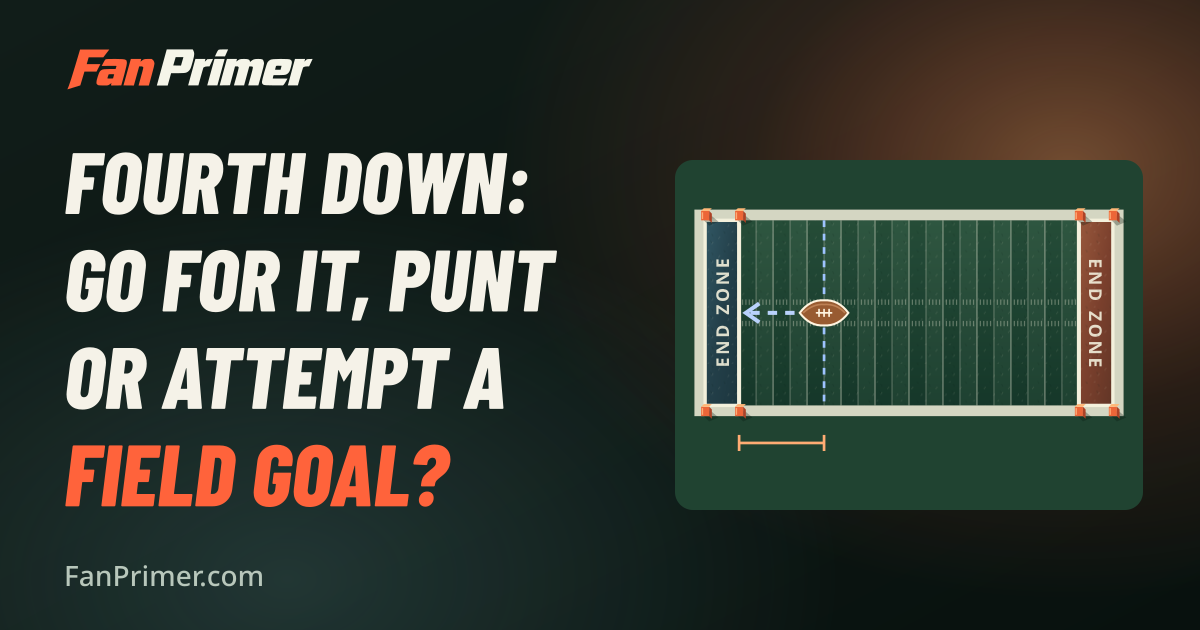
Fourth down is the team’s last try in a set. It can try to reach the target, kick for 3 points, or punt the ball farther away.
See how it works
| Choice | What success buys | What can go wrong |
|---|---|---|
| Go for it | Reach the target and keep the drive, or score a touchdown. | Fall short: opponent takes over at the ending spot. |
| Punt | Trade possession for a longer opponent journey. | A return, touchback or poor kick can erase territory. |
| Field goal | A successful kick scores 3 points. | An ordinary miss gives the opponent the ball. |
Own 25 · 4th & 12
A failed attempt with no gain gives the opponent only 25 yards to attack. A punt can make that journey longer.
Opponent’s 2 · 4th & 1
1 yard reaches a fresh set; 2 yards reaches the goal line. Converting and scoring are different outcomes.
Trailing by 4 · 40 seconds left
Before the kick 17–21
After a successful field goal 20–21
Three points still leave this team behind. With little time left, the offense may need a touchdown.
Missing the target gives up the ball
The offense normally gets up to 4 tries. If its ordinary run or pass on the 4th falls short, the opponent takes over where the play ended. Reaching the target earns fresh tries or a score. A shorter distance generally makes the needed gain more achievable.
A punt trades the ball for field position
Far from the opponent’s goal, a team can kick the ball away and try to make the opponent start farther back. Returns and touchbacks affect where it actually starts. Punting normally ends the kicking team’s possession; it does not give that team new tries.
A field goal can score 3 points
The kick must cover the remaining distance to the goal line, the 10-yard end zone, and the distance back to the holder. The holder is often about 7 yards behind the starting line. From the opponent’s 30, that makes about a 47-yard kick. The holder’s position can vary.
Missing the kick can give up valuable ground
For an ordinary missed field goal crossing the starting line untouched by the receiving team, the opponent normally starts where it was kicked, or at its own 20 if the kick was from inside that 20. A kick 7 yards behind the opponent’s 30 can therefore give it the ball at its own 37 after a miss. Blocks and returns can change the result.
The score and clock can change the choice
Down 4 points with 40 seconds left, a team cannot take the lead with a field goal alone. It may need to chase a touchdown even on a difficult 4th down. Early in a tied game, taking 3 points can be more attractive. Punting late while behind may leave too little time to win the ball back.
A reasonable decision can still fail
A coach has to choose before seeing the result. The chance of gaining the needed yards, making the kick, and winning after each result all matter. These examples show the tradeoffs, not a universal recommendation. Wind, the kicker, blocking and the opponent can change the choice.