Foundations
What are the positions in American football?
The takeaway
Each team has 11 players on the field. Some carry, catch or protect the ball; others tackle, chase the quarterback or defend against passes.
See how it works
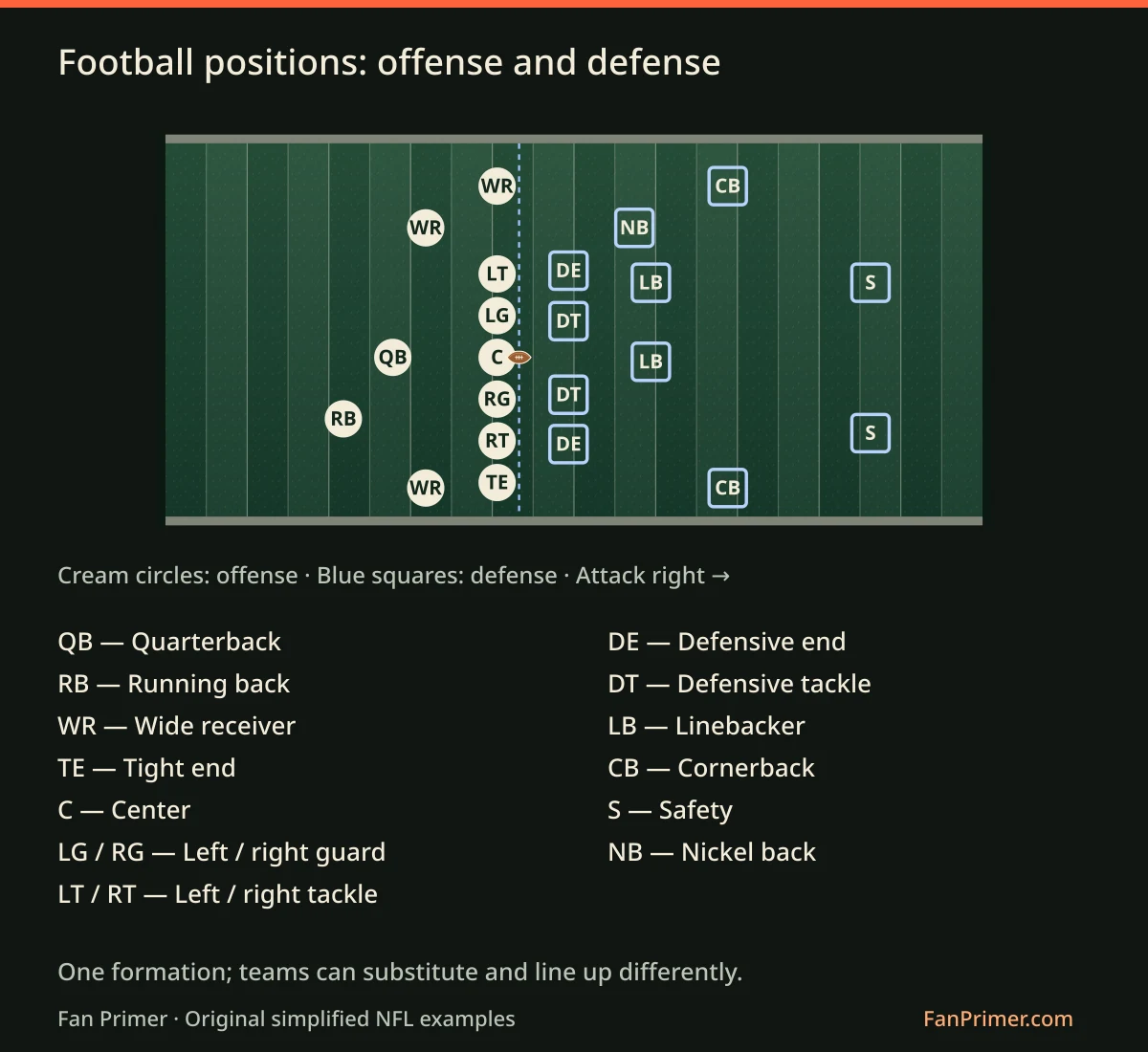
Offense · 11 players
Defense · 11 players
● Offense →□ Defense⇢ Pass / route
The offense attacks right. Left and right positions are named from the offense’s view toward the goal.
| Abbreviation | Position | Typical job and location |
|---|---|---|
| QB | Quarterback | Behind the center; usually receives the snap, then passes, hands off or runs. |
| RB | Running back | Behind the line; carries handoffs and can catch or block. |
| WR | Wide receiver | Usually outside or in a slot; runs routes to catch passes and also blocks. |
| TE | Tight end | Beside the line in this example; combines blocking with receiving. |
| C | Center | Middle of the offensive line; snaps the ball and then blocks. |
| LG / RG | Left / right guard | Either side of the center; protects the passer and opens running lanes. |
| LT / RT | Left / right tackle | Outside each guard; blocks on the edges of the offensive line. |
| DE | Defensive end | Edge of the defensive line; pressures the passer and contains runs. |
| DT | Defensive tackle | Interior of the defensive line; attacks inside runs and the passer. |
| LB | Linebacker | Behind the defensive line; tackles, covers or joins the rush. |
| CB | Cornerback | Often opposite a wide receiver; tries to prevent completed passes. |
| S | Safety | Often deeper; helps cover passes and tackles runners who get through. |
| NB | Nickel back | An extra defensive back; replaces a linebacker in this pictured defense. |
The jobs stay useful even when players move
The picture shows a running back, a tight end and 3 wide receivers against 5 defensive backs, a setup called nickel defense. Both teams still have 11 players. Teams can replace players and line up differently. A position names a player’s usual job, not one spot he must always stand on.
A tight end can block or catch
The tight end here starts beside the row of blockers. He can help block or run out to catch a pass. Wide receivers usually start farther toward the sides. The running back starts behind the line. Moving these players can change which defenders have to handle them.
A job title does not limit every play
The quarterback can run. A running back can catch. A safety, normally a deeper defender, can rush toward the quarterback on a blitz. The play gives each player a particular task. Replacing one player with another changes the mix of skills, not the limit of 11.
Kicking plays bring different specialists
Special teams are the groups used for kicking plays. A kicker attempts field goals and many kickoffs; a punter kicks the ball away on punts. A long snapper sends the ball back, a holder positions it for place kicks, and returners try to run kicks back. These groups normally replace the offense or defense and still use 11 players. One player may serve in more than one group.
Save the illustrated explanation