Penalties & rulings
Why can offensive holding in the end zone produce a safety?
The takeaway
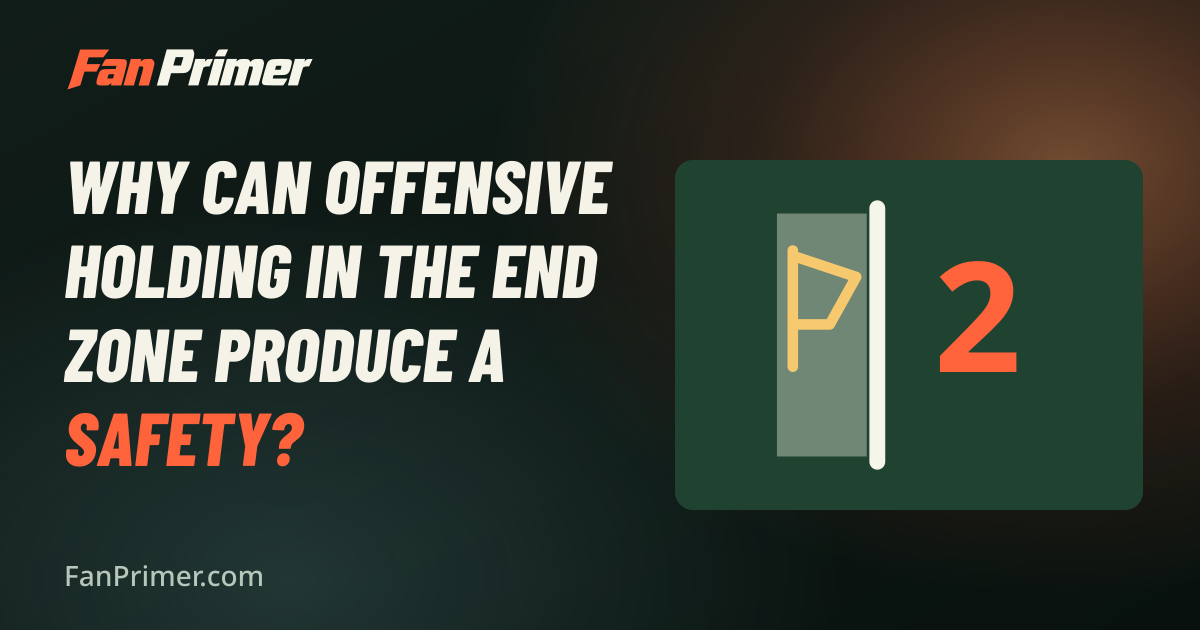
Holding behind the offense’s own goal line can give the defense 2 points. The foul’s location matters even if the quarterback completes a pass.
See how it works
The hold is behind the offense’s goal line
The snap starts at the offense’s 5. A blocker holds 2 yards inside his own end zone while the quarterback has the ball. An accepted penalty there produces a safety.
The ruling after the play
- 1Pass completed
The quarterback gets the ball away; play then ends.
- 2End-zone penalty accepted
The pass gain does not stand. Award a safety.
A completed pass does not erase the hold. The defense can take the end-zone enforcement rather than the play’s result.
Gold ring: hold · Blue dashed line: quarterback with ball · White line: own goal line · Offense advances right.
A safety gives the other team 2 points
A safety is one way the defense can score. For this holding example, officials do not simply move the offense halfway back toward its goal. If the defense accepts enforcement at the hold behind that goal line, the result is 2 points for the defense.
The blocker’s foul can decide the result
The offense starts at its own 5-yard line. Its quarterback drops into the end zone, and a blocker illegally restrains a defender 2 yards behind the goal line. The quarterback then completes a pass to the 28. Accepting the end-zone holding penalty replaces that gain with a safety. The defender does not have to sack the quarterback.
The quarterback’s location alone is not enough
A quarterback standing in the end zone does not turn every holding foul into a safety. Locate where the illegal restriction happens and where the rule permits enforcement. A hold at the offense’s 3-yard line is in the field of play, even if the passer is farther back. That ordinary yardage penalty can be limited to half the distance.
A safety also changes who kicks next
The team that conceded the safety must next put the ball in play with a free kick from its own 20-yard line. This is different from a touchback, which normally awards possession at a specified yard line without giving the other team 2 points.