Foundations
What does “their own 40” versus “the opponent’s 40” mean?
The takeaway
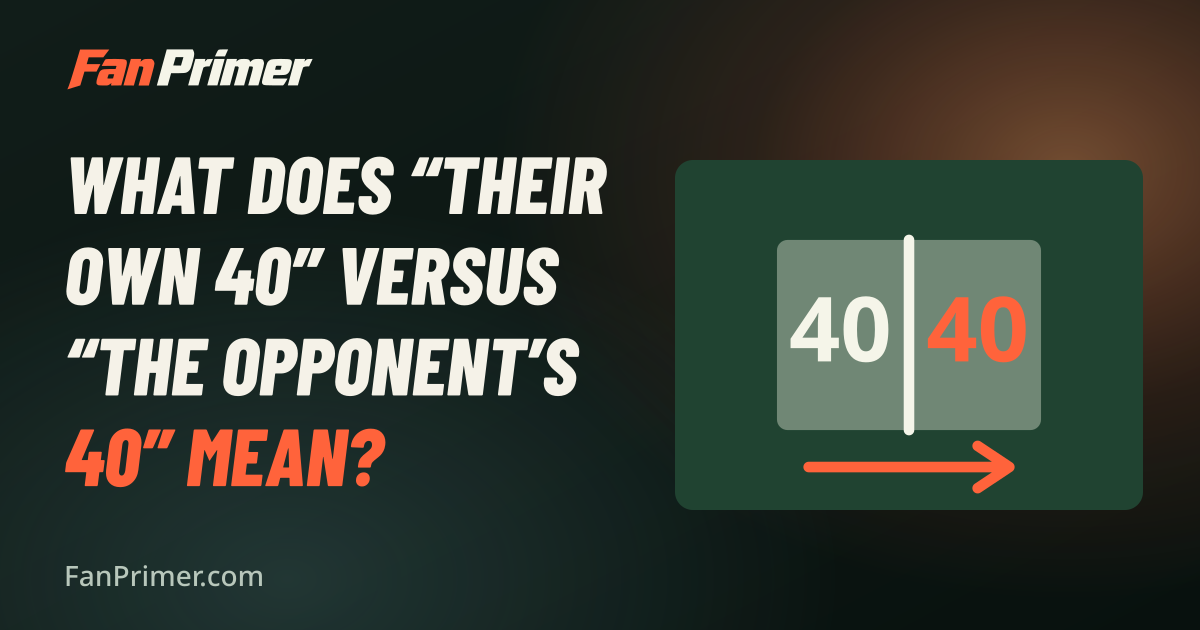
The same yard number appears on both halves. “Own” identifies the offense’s half; “opponent’s” identifies the half closer to the goal it is attacking.
See how it works
Own 40
The ball is still on the offense’s side of midfield. Advance 60 yards to reach the opponent’s goal line.
Opponent 40
The ball has passed midfield. The offense is now 40 yards from the opponent’s goal line.
Offense advances → · The 50 is midfield · Each end zone lies beyond its goal line.
The numbers count toward midfield from both ends
A regulation field has 100 yards between goal lines. Yard numbers rise toward the 50, then fall toward the opposite goal line. That creates two 40-yard lines, two 30-yard lines and so on. The number needs a team or side to identify one location.
Use the team with the ball as the reference
Its own goal line is behind the direction it is attacking. At its own 40, it has covered 40 of the 100 yards from that goal line. The other 60 remain before the opponent’s goal. At the opponent’s 40, it has crossed midfield and has 40 remaining.
Possession can change the name of the same place
Suppose the defense intercepts at the old offense’s 40 and is downed there. The next offense describes that same location as the opponent’s 40. The turf did not move; the team whose perspective you are using changed.
Field position is different from yards still needed
A team can face 2nd try with 7 yards needed at either 40-yard line. The 7 describes the distance to its first-down target, not the distance to the end zone. Keep the try, required gain and field location separate.