Foundations
How does the NFL measure a ball carrier’s speed?
The takeaway
Sensors in players’ shoulder pads let the NFL track movement. A displayed top speed is the runner’s fastest moment, not his average over the whole play.
See how it works
Positions arrive at short intervals
Five invented positions span 0.4 seconds. A wider gap over the same time means a faster interval. The gold numbers are yards, not MPH.
Peak and average answer different questions
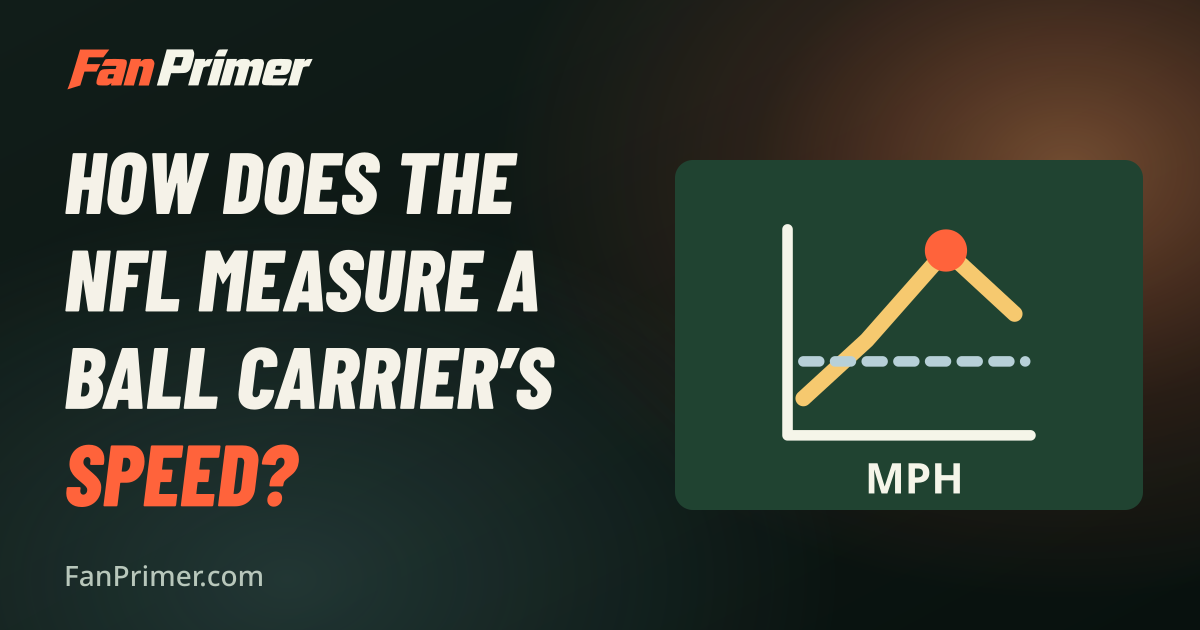
The largest gap is 0.9 yards in 0.1 seconds: 9 yards per second, or 18.4 MPH. The full sample averages 15.3 MPH.
Gold dots: invented tracking positions or interval speeds. Solid gold: speed trace. Dashed blue: full-sample average. This arithmetic illustration does not reproduce the NFL’s speed-estimation software.
The measurement starts in the shoulder pads
RFID tags, small tracking devices in the pads, send information to receivers around the stadium. The NFL describes recording data 10 times each second to track movement and speed. Its Fastest Ball Carriers list reports the highest speed reached while carrying the ball on a play, including offense and kick returns.
Compare distances over equal bits of time
In this invented straight run, the player covers 0.7, 0.9, 0.8 and 0.6 yards in four equal 0.1-second intervals. The 0.9-yard stretch is fastest: 0.9 ÷ 0.1 = 9 yards per second. Converting yards to miles and seconds to hours gives about 18.4 MPH. This example explains speed; it does not reproduce the NFL’s filtering or estimation software.
Top speed and average speed answer different questions
The whole sample covers 3 yards in 0.4 seconds: 7.5 yards per second, about 15.3 MPH on average. Its fastest interval is quicker. Likewise, a published top speed does not mean a runner maintained it while accelerating, turning and finishing. A timed sprint measures how long a fixed distance takes, which is different again.