Foundations
Where do the seven NFL officials stand, and what does each watch?
The takeaway
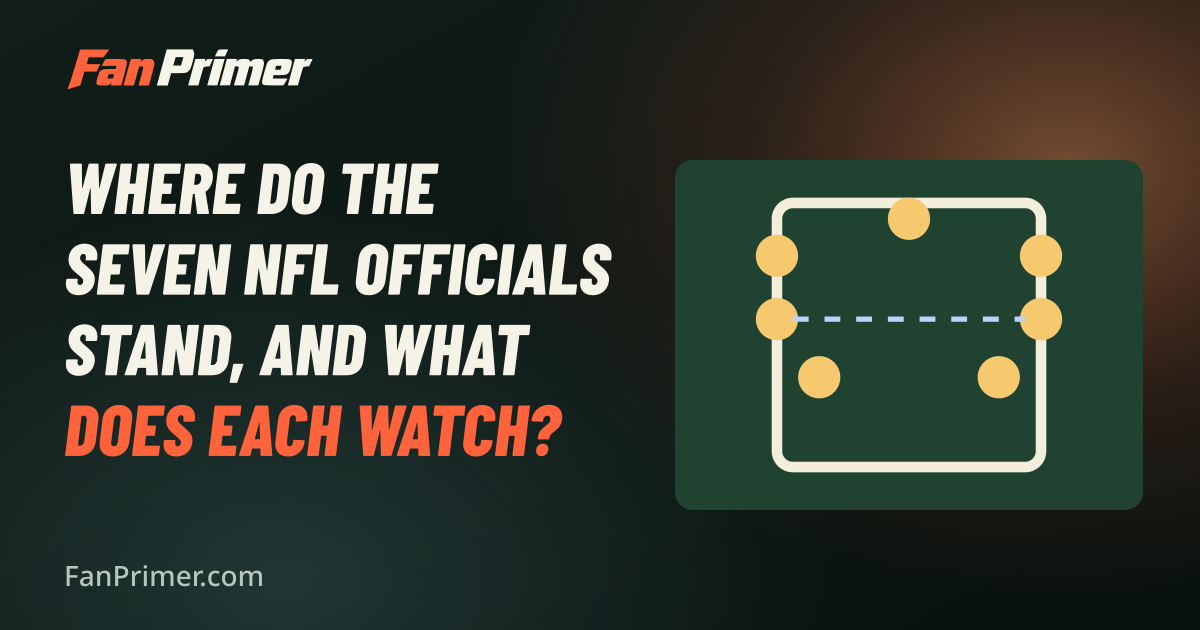
Seven officials watch different parts of the same play. Their positions help them judge the quarterback, blocking, catches and boundaries without all watching only the ball.
See how it works
Different sightlines for the same play
Offense advances ↑
Cream circles: offense · Blue squares: defense · Gold markers: officials
Line of scrimmage
- RReferee
- Behind the offense
Game oversight, quarterback action and contact on the passer or kicker.
- UUmpire
- Behind the offense, opposite R
Line blocking, player conduct and equipment.
- DJDown Judge
- At the line, near one sideline
Pre-snap line action, near sideline, forward progress and the down / chain crew.
- LJLine Judge
- At the line, opposite DJ
Pre-snap line action, passer relative to the line and whether a punt crosses it.
- FJField Judge
- Deep, on LJ’s side
Deep receivers, near sideline, catches and interference; successful goal attempts with BJ.
- SJSide Judge
- Deep, on DJ’s side
Deep receivers, near sideline and catches; second Umpire on field goals and kicked tries.
- BJBack Judge
- Deep middle
Deep catches, end line and play clock; successful goal attempts with FJ.
One crew divides the work
The Referee oversees the game and settles rule disagreements among the officials. He does not watch every collision. The crew splits its attention among the quarterback, blockers, receivers and boundaries, giving the same play several viewing angles.
Their starting positions explain what they can see
On an ordinary play, the Referee and Umpire start behind the offense. The Down Judge and Line Judge stand on opposite sidelines at the starting line. The Field Judge, Side Judge and Back Judge work farther downfield. Their positions adapt to the players and play; they are not fixed for the whole game.
One official may watch action away from the pass
Imagine a pass flying toward the far sideline while a defender hits the quarterback. The Referee can watch the passer while a deeper judge watches the receiver and boundary. Both decisions matter, even though the ball is only in one place.
Kicks change who watches what
For a field goal or kicked extra point, the Field Judge and Back Judge judge the kick. The Side Judge joins the work near the line as a second Umpire. On punts, the Referee watches the kicker and contact while others watch the line, receivers and return. Their assignments change with the play.