Penalties & rulings
How do encroachment and a neutral zone infraction differ from offside?
The takeaway
Encroachment involves defensive contact. A neutral zone infraction can stop play without contact. Ordinary offside concerns a player’s position at the snap.
See how it works
Encroachment: contact before the snap
The defender enters the neutral zone and touches an opponent before the snap. Officials stop play immediately.
Neutral zone infraction: protective reaction
The defender enters the gap and immediately makes a nearby blocker react to protect himself. No contact is needed.
Offside: across at the snap
No earlier whistle condition occurs. The defender is still in the neutral zone when the ball is snapped.
Back in position: no foul in this example
With no contact, immediate reaction or other violation, the defender returns before the snap and play can begin legally.
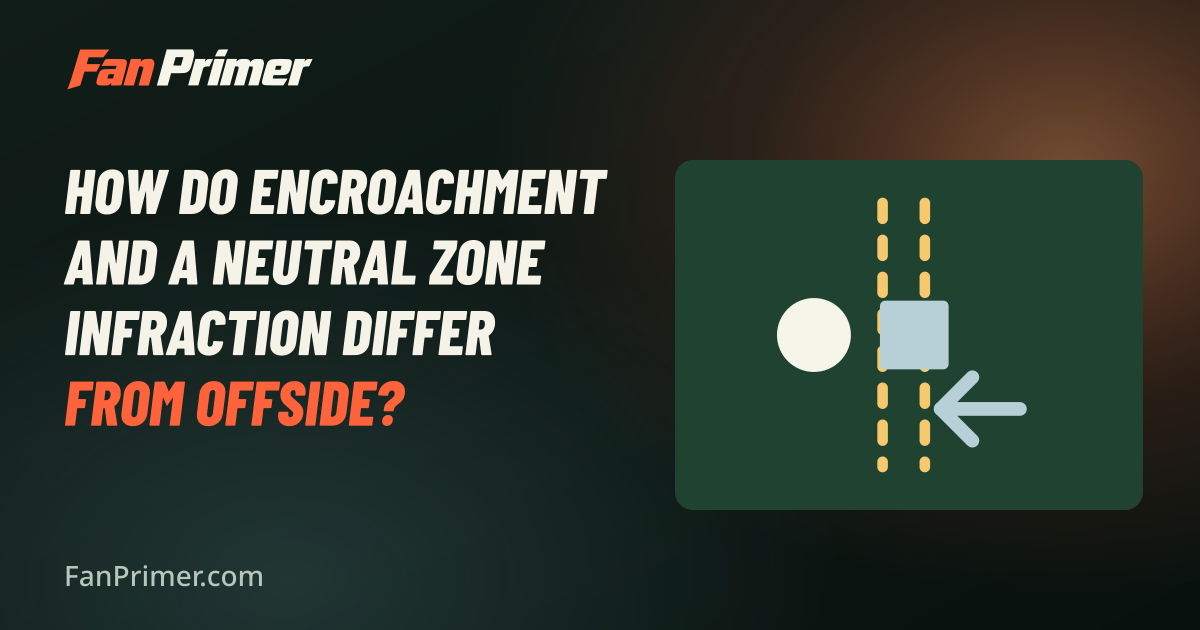
Cream circle: offense · Blue square: defense · Shaded gap: neutral zone · Positions are schematic.
The neutral zone is a gap, not just a painted line
Before the snap, the teams’ starting lines are separated by the length of the football. That space is the neutral zone. It moves with the ball; it is not one of the permanent yard lines on the turf.
Contact creates encroachment
If a defender enters that zone and contacts an offensive player or the ball before the snap, officials stop play. Interfering with the ball during the snap also qualifies. The ordinary penalty is 5 yards before the down begins.
An immediate protective reaction can create a neutral zone infraction
A nearby offensive player may react immediately to protect himself when a defender enters the neutral zone. Officials can charge the defender rather than treating that reaction as a false start. An unrelated player moving later is not the same situation. The rule defines which players are close enough.
A clear path to the passer can stop play too
Officials also stop a defender who has gone beyond the neutral zone, is level with or past an offensive lineman, and has an unobstructed path to the quarterback or kicker. Nobody needs to be touched or jump first. The normal neutral-zone penalty is 5 yards.
Ordinary offside is judged at the snap
If no condition requires an earlier whistle, the defender can sometimes retreat legally before the snap. If he is still in or beyond the neutral zone when the ball is put in play, ordinary offside applies and the play can continue. The offense can then consider the play’s result versus the 5-yard penalty. A separate rule applies when the offense legally snaps with defenders still across during a half’s last two minutes.