Season & playoffs
How do ties change an NFL team’s winning percentage?
The takeaway
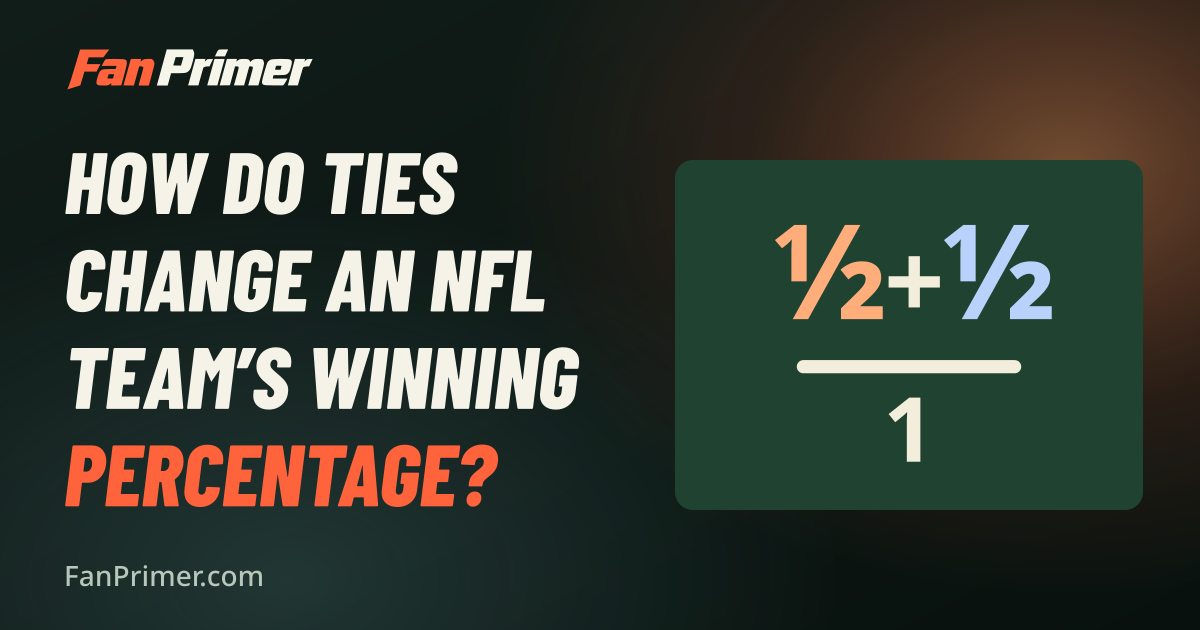
To calculate winning percentage, count a tie as half a win, then divide by every game played. Do not leave tied games out.
See how it works
WinLossTie: half a win
One tie puts a team ahead of one loss
10½ ÷ 17 is greater than 10 ÷ 17.
Two ties can replace one win and one loss
Both have 9 equivalent wins in 17 games. Their percentages are equal.
Fractions decide the order. The percentages shown here are rounded only after the records are compared.
Keep ties in the game total
Add wins plus half the ties, then divide by wins, losses and ties combined. A team with 0 wins, 0 losses and 1 tie is .500. Ignoring that game would leave no useful calculation.
One tie can put a team ahead
Owls at 10–6–1 have 10½ equivalent wins in 17 games. Foxes at 10–7 have 10. Owls lead by percentage without needing a standings tiebreaker. A tied game does not necessarily create tied standings.
Different records can have the same percentage
Comets at 8–7–2 have 8 wins plus two half-wins: 9 equivalent wins in 17 games. That matches Otters at 9–8. If their order matters, use a tiebreaker. The arithmetic does not turn tied games into actual wins.
Compare fractions when game totals differ
Four wins in five games is .800. Five wins in seven games is about .714. The second team has more wins but a lower percentage. Different totals can also arise in common-games tiebreakers. Keep the exact fractions rather than deciding from rounded display values.
A win is worth more than a tie
Replacing a loss with a tie adds half a win divided by games played. Replacing a win with a tie subtracts that amount. Over 17 games, the difference is 1/34, about 2.94 percentage points. Its playoff effect depends on other records and any applicable tiebreaker.