Offense & play design
Why can a pass travel farther than its air-yard number?
The takeaway
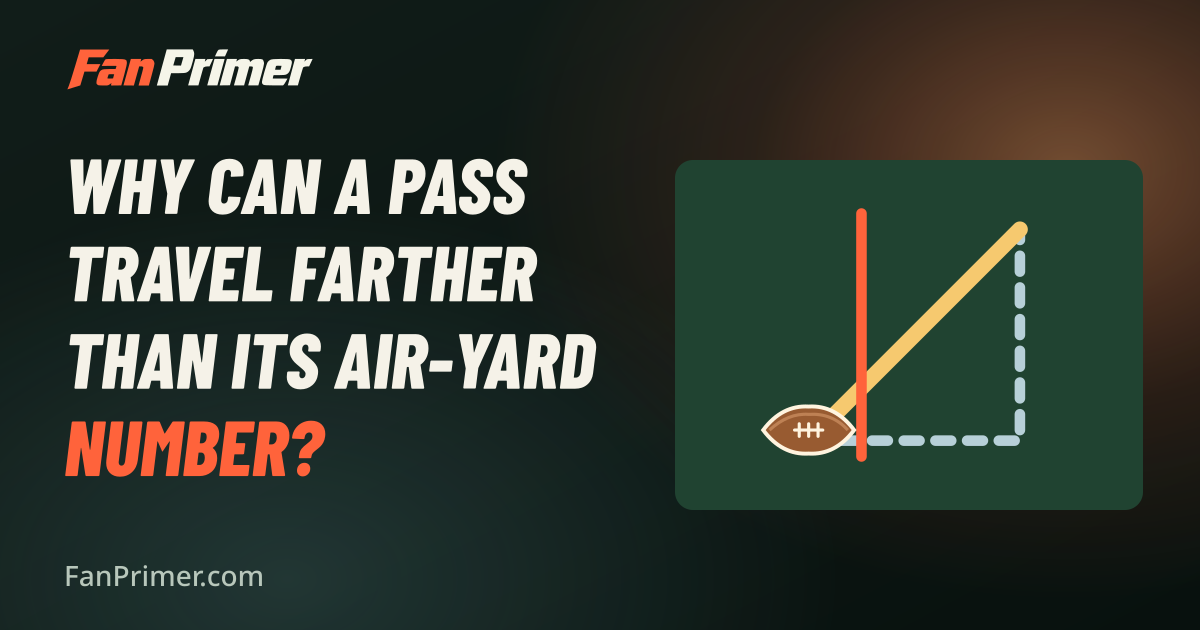
Air yards count how far a catch is beyond where the play began. The throw itself can travel farther because the quarterback starts behind that line.
See how it works
Release 5 yards behind the line
The catch is 20 yards beyond where the play began. Throwing from 5 yards behind makes the throw 25 yards.
Deeper release, wider target
The throw travels 27 yards forward and 24 sideways. The straight diagonal between those points is about 36.1 yards.
Cream circles: quarterback (QB) and receiver (R). Dashed blue: snap line and downfield ruler. Gold: straight release-to-catch distance. Overhead schematic; no height or curved flight path.
The two measurements start in different places
The play begins at the 30 and the receiver catches at the 50: that is 20 air yards. If the quarterback throws from the 25, the ball travels 25 yards forward from his hand. His starting point does not change the 20-yard depth measured from the play's starting line.
A throw across the field adds distance
In the second example, the throw starts at the 23 and reaches the 50, a forward difference of 27 yards. It also travels 24 yards sideways. The straight diagonal between those points is about 36.1 yards. The catch still has 20 air yards.
Neither number traces the whole arc
Next Gen Stats distinguishes downfield air yards from distance between release and reception. The overhead ruler here explains that difference without measuring the ball's curved flight. A catch behind where the play began can have negative air yards, even though the ball traveled a positive distance. Yards run after catching are counted separately.