Season & playoffs
How are three NFL wild-card places selected from a multi-team tie?
The takeaway
Award tied wild-card places one at a time. Start with each division's highest remaining candidate, choose a winner, then repeat for the places still open.
See how it works
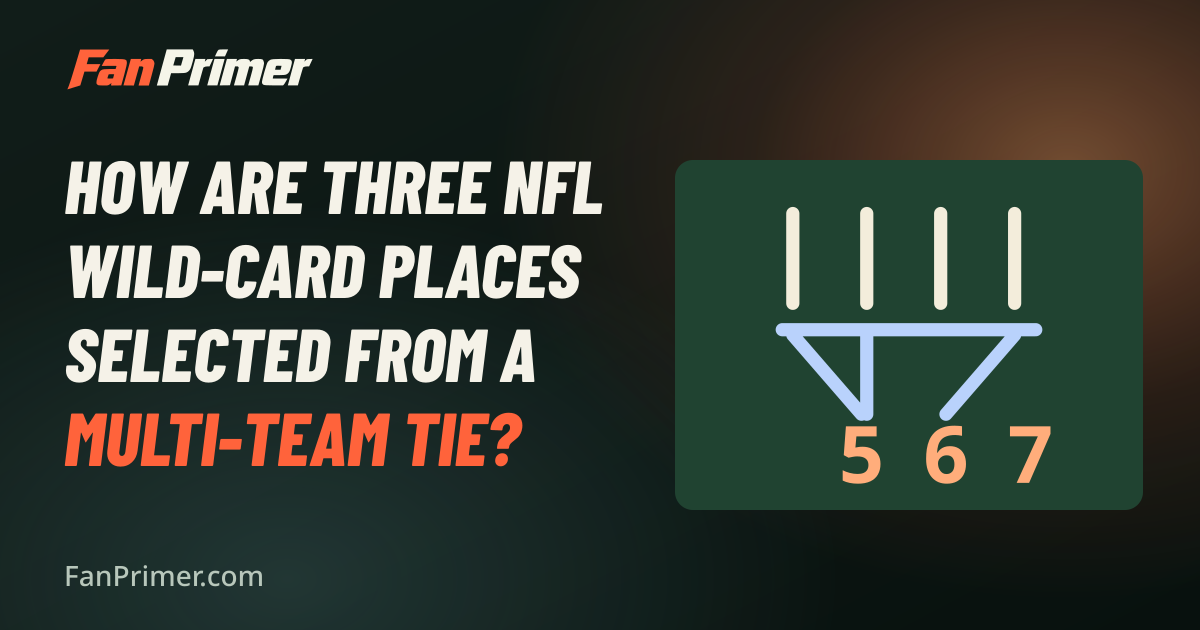
Four tied candidates, three available places
All 4 clubs: 10–7 · none is a division champion
Otters and Comets belong to two other divisions. Owls’ 2–0 head-to-head series puts them ahead of Foxes.
Select one, then let the remaining clubs try again
- Seed 5Start selection
Foxes wait behind their division’s representative.
Owls9–3 conferenceOtters8–4 conferenceComets7–5 conferenceNo qualifying head-to-head sweep.
Owls take the first wild-card place.
↳ Foxes return for the next selection.
- Seed 6Restart selectionFoxes6–6 conferenceOtters8–4 conferenceComets7–5 conference
No qualifying head-to-head sweep.
Otters take the second wild-card place.
- Seed 7Restart selectionFoxes6–6 conferenceComets7–5 conference
No head-to-head meeting.
Comets take the third wild-card place.
The displayed numbers are conference records, not overall records. Every candidate’s overall record is 10–7.
A division rival can wait during one selection and return for the next place.
Choose one qualifier per round of comparison
Each conference has 3 wild cards for teams that did not win divisions. A tie among at least 3 clubs across divisions is resolved one place at a time. One pass through the rules does not permanently rank every club.
Each division sends its leading candidate first
Rank tied division rivals with the division rules. Here, Owls and Foxes are 10–7, but Owls won both meetings, so Foxes wait. Owls compare with Otters and Comets, the 10–7 representatives of two other divisions.
Head-to-head needs a sweep of the group
A representative must have beaten every other representative, or lost to every other representative, for the multi-team head-to-head sweep test to apply. One win is not enough. Owls played neither other representative, so this example moves to conference record.
Award one place, then start again
Owls are 9–3 in conference games, Otters 8–4 and Comets 7–5. Owls take the first wild card, seed 5. Foxes now enter for that division. Their own conference record is 6–6; they do not inherit Owls' result.
Fill each remaining place separately
With no qualifying sweep, Otters' 8–4 wins seed 6 over Comets and Foxes. Restart for the final pair. They did not meet, so conference record decides: Comets' 7–5 beats Foxes' 6–6 for seed 7. Foxes miss the playoffs.
Keep the established division order
After one division candidate qualifies, its next team can enter. Preserve the division ranking already established. A team waiting behind a division rival is excluded from that particular comparison, rather than automatically out of playoff contention.
A smaller tied group can require another restart
If a step leaves two teams, restart the two-team wild-card rules at head-to-head. If four representatives become three, restart at the sweep test. If all tied teams share one division, use the division procedure.
Continue in order if conference record ties
Next compare common games, requiring at least 4; strength of victory; strength of schedule; combined scoring and points-allowed rankings in the conference and league; net points in conference games; net points in all games; net touchdowns; then a coin toss. Strength measures opponents' results, and net means the team's total minus opponents' total. Award one place, then restart for the remaining tie.