Downs & possession
When is a loose ball a fumble rather than an incomplete pass?
The takeaway
Did the player control the ball before losing it? For a throw, watch when the hand moves forward. For a receiver, check whether he finished the catch.
See how it works
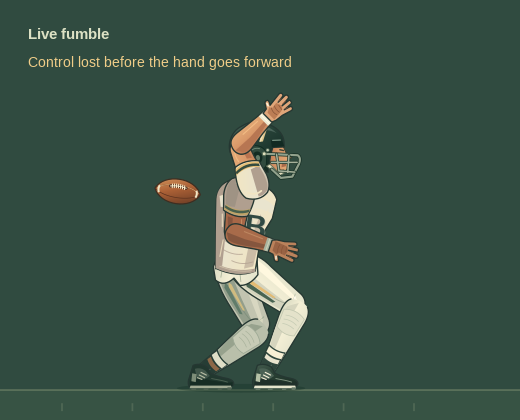
Control when the throwing hand starts forward
Loss before forward motion
Controlled forward throwing motion
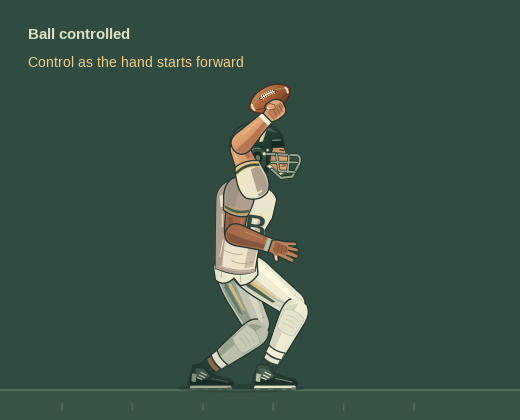
The fumble leaves before forward hand movement; the pass stays controlled as the throwing hand moves forward.
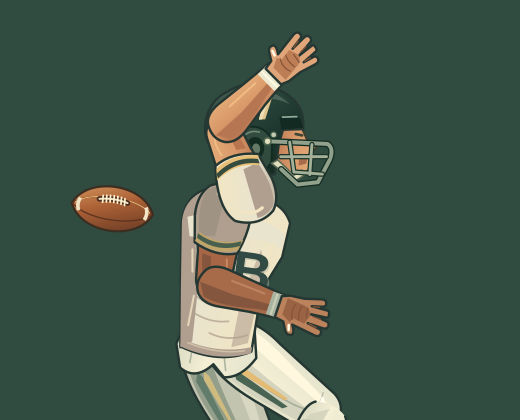
Inspect the contact pictures
Loss before forward motion
Controlled forward throwing motion
Cream: offense · Blue: defender · Gold: contact or control
The player must have had the ball first
A fumble starts with a player losing a ball he possessed. If a receiver never finishes the catch and the forward pass hits the ground, the pass is incomplete. A defender picking it up after that cannot make it a fumble.
Watch the hand at the start of the throw
In one picture, the quarterback loses control before his hand starts forward. The ball is a fumble and can still be picked up. In the other, he controls it when he deliberately moves his hand forward to throw. The uncaught forward pass then hits the ground and ends the play.
Two feet do not always finish a catch
A receiver needs control, the required contact inside the field, and a normal football action or time to make one. Tucking the ball and turning can help finish the catch. Compare dropping a pass straight onto the grass with catching it, taking several running steps, then having it knocked away. Only the second is a fumble.
A forward bounce does not prove it was a pass
A fumble can bounce forward accidentally. Its direction does not turn it into a forward pass. A quarterback can also fumble while pulling the ball back toward his body or drawing his arm back again, even after an earlier forward movement.
The call changes what happens next
An uncaught forward pass uses a try and returns the ball to the starting spot. A fumble can remain available for either team to pick up and run with until play ends. Special restrictions apply on 4th down, after the two-minute warning and during an extra-point play.