Penalties & rulings
False start vs. offside: what’s the difference?
The takeaway
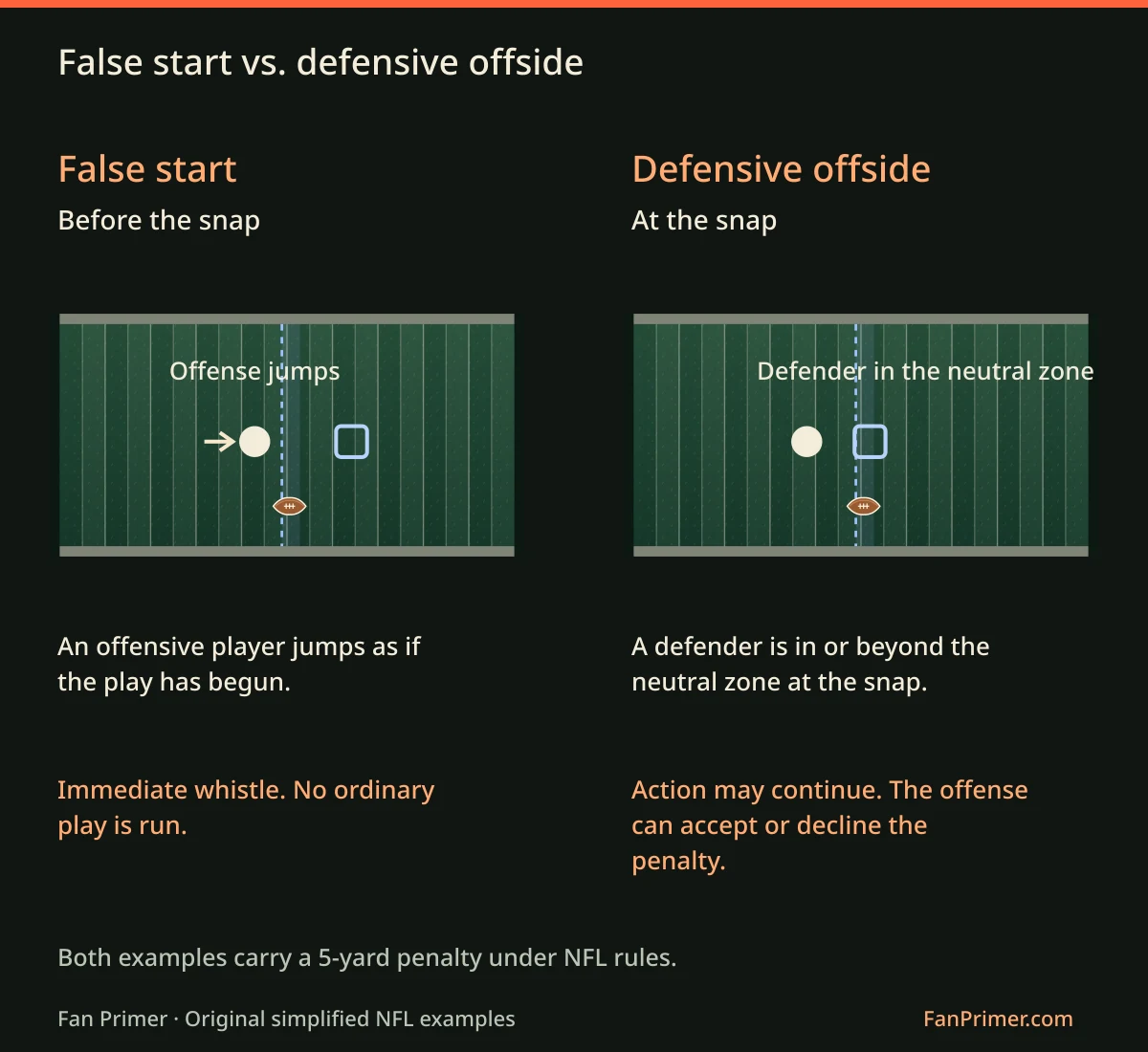
A false start is an illegal early offensive start. Ordinary defensive offside means a defender is across the starting boundary at the snap. Both usually cost 5 yards.
See how it works
Whistle stops play. 5-yard penalty.
5-yard penalty. Play may continue.
First check which side and which moment
The snap is the action that starts an ordinary play by moving the ball backward from the center. A set offensive player who abruptly acts as though play has started can commit a false start before that snap. Ordinary defensive offside instead concerns where the defender is when the ball is snapped.
A false start stops the ordinary play before it begins
Officials whistle a false start immediately and enforce the ordinary 5-yard penalty before the snap. The offense has not used a try. At its own 30 on 2nd try, needing 7 yards, the offense moves to the 25: still 2nd try, now needing 12 yards. The target at the 37 stays fixed.
Ordinary offside can let the play continue
A defender who is in or beyond the neutral zone at the snap can draw a live-ball offside flag. The offense may finish the play before choosing between its result and the available penalty. From the same 2nd-and-7 situation at the 30, an ordinary accepted 5-yard offside leaves 2nd try with 2 yards needed at the 35; offside does not itself guarantee a fresh set.
Not every early movement is a false start
Players may legally shift or go in motion under specific rules. A permitted backfield player moving sideways is different from an abrupt movement that simulates the start. A quarterback’s ordinary spoken cadence is not the same as a sudden physical action that illegally draws a defender offside.
A defender can cause the offense to react
If a defender enters the neutral zone and makes a nearby offensive player immediately move to protect himself, officials can call a neutral zone infraction on the defense. Contact before the snap can instead be encroachment. Both normally stop play immediately. Do not assume the first offensive player you see move must be guilty.
Save the illustrated explanation