Penalties & rulings
When does a sideline tackle become a late hit out of bounds?
The takeaway
Once a runner steps out, defenders must avoid a needless hit. A tackle already started inside the field needs a different judgment.
See how it works
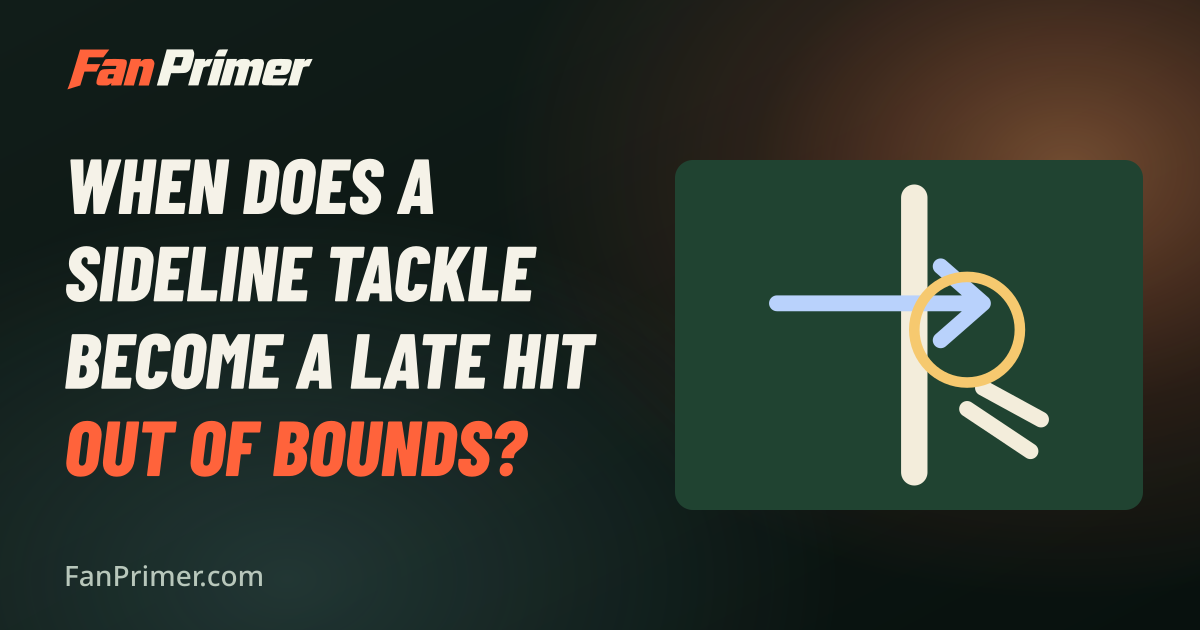
Runner approaches the sideline at the right · White paint is out of bounds
Read the approach and boundary together
Contact begins inbounds
The defender wraps the runner while the runner’s feet are still inside the sideline. Their momentum toward the boundary is relevant context, not permission for a later blow.
A new hit after a clear exit
The runner has stepped across the white stripe. The defender starts a fresh forcible hit despite the clear exit, instead of making an effort to avoid contact.
Cream R: runner · Blue D: defender · White stripe: sideline · Gold: contact
One foot can end the run
A runner is out when a foot touches the sideline or the ground beyond it. Both feet do not have to cross. Leaning over the line while still touching only ground inside does not by itself make the runner out. Contact with another player, an official or a pylon has its own boundary rules.
The defender must try to avoid the hit
A forceful hit on a runner who is already out can be a foul. Officials consider whether the defender should have recognized the exit and tried to avoid contact. A tackle started inside the field may carry both players out, but that does not allow an extra shove or throw afterward.
There is no free step at the sideline
The passer's separate protection after a throw does not give defenders one allowed step before hitting an out-of-bounds runner. Officials judge the timing, approach and effort to stop. A defender having a foot outside the field does not by itself decide whether the hit is legal.
A close boundary play needs context
A runner moving along the sideline may leave doubt about whether he stepped out. That differs from a runner who has clearly left the field. Uncertainty in a close play does not give a defender permission to hit someone who is plainly out.
Follow Owl's foot, then Fox's hit
Owl steps on the white sideline. Fox sees him leave, has not started a tackle, and then drives a shoulder into him: that is a late hit. A wrap begun inside the field needs a different judgment. The usual penalty is 15 yards and, against the defense, a fresh first try. A flagrant hit can also mean ejection.