Penalties & rulings
What do the most common NFL referee signals mean?
The takeaway
A referee's gesture helps identify the ruling, but the same signal can have several meanings. Use the play and spoken announcement to complete the answer.
See how it works
Recognize the hands, then identify the play
Successful score
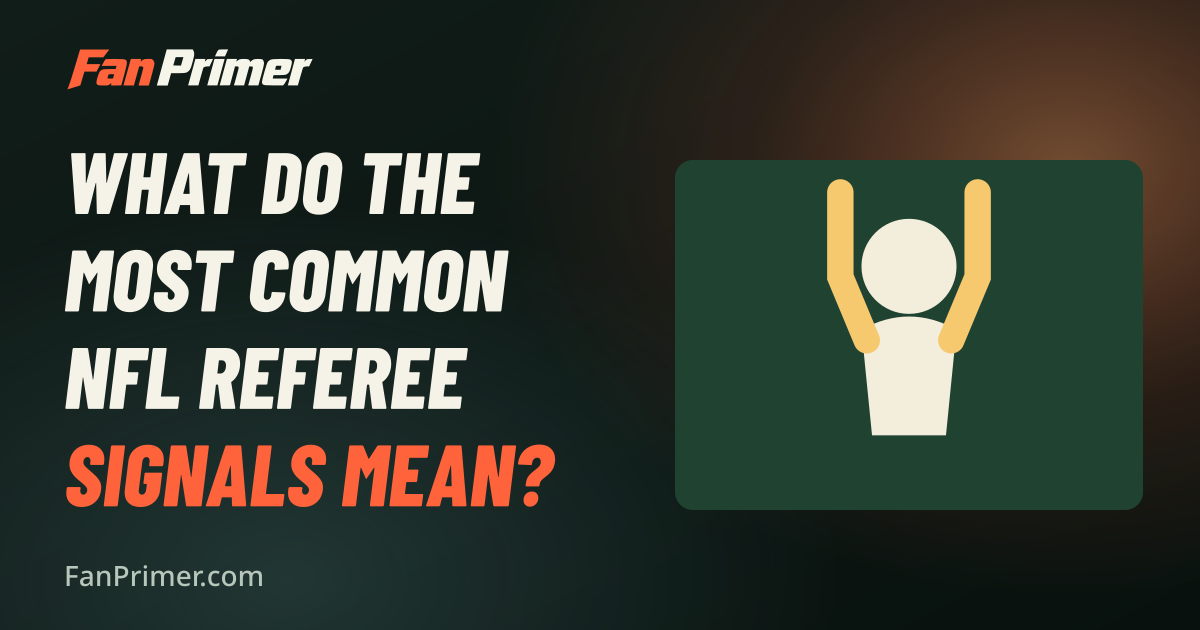
Both arms straight up, hands apart.
Touchdown, field goal or successful try. The play determines the points.
Safety
Hands meet above the head.
A safety is the ruling; do not confuse the joined hands with the separate scoring arms.
First down
Arm points toward the defense’s goal.
Shows the first-down award and direction of the next attack.
Incomplete / no good
Hands sweep sideways across the body.
Can also mean a missed goal, declined penalty or play over. Use the context.
Timeout
Arms cross above the head.
A stoppage. Follow-up gestures can identify an official timeout or touchback.
Delay of game
Arms folded across the chest.
Also used for an excess timeout; the announcement identifies the call.
False start and other calls
Forearms rotate around each other in front.
False start is one use. Illegal formation and several kick violations share this motion.
Holding
One hand grips the opposite wrist; that fist is closed.
Identifies holding. Enforcement still depends on the team and play.
Pass / fair-catch interference
Both open hands push forward from the shoulders.
The same gesture covers interference with a forward pass or a fair catch.
Raised arms need the scoring context
Both arms straight overhead can signal a touchdown, a successful field goal or a successful extra-point attempt. The gesture alone does not specify the points. For a safety, the official brings both palms together above the head.
Some gestures cover several calls
Sweeping the arms can indicate an incomplete pass, a missed goal, a declined penalty or that play is over. Rotating the forearms can indicate a false start and some other rulings. Listen for the announcement before assigning one meaning.
A foul signal is only part of the decision
The holding gesture identifies a foul; it does not tell you where the penalty will be measured or how many yards actually move. A first-down signal points in the direction of the new set of tries, but does not tell you why it was awarded.
Use what just happened
After a dropped forward pass, the sweeping signal means incomplete. After a missed field-goal attempt, the same motion fits a different result. A timeout gesture also needs the follow-up information that identifies the type of stoppage. Read the gesture together with the play.