Penalties & rulings
How far can a quarterback cross the line before a forward pass becomes illegal?
The takeaway
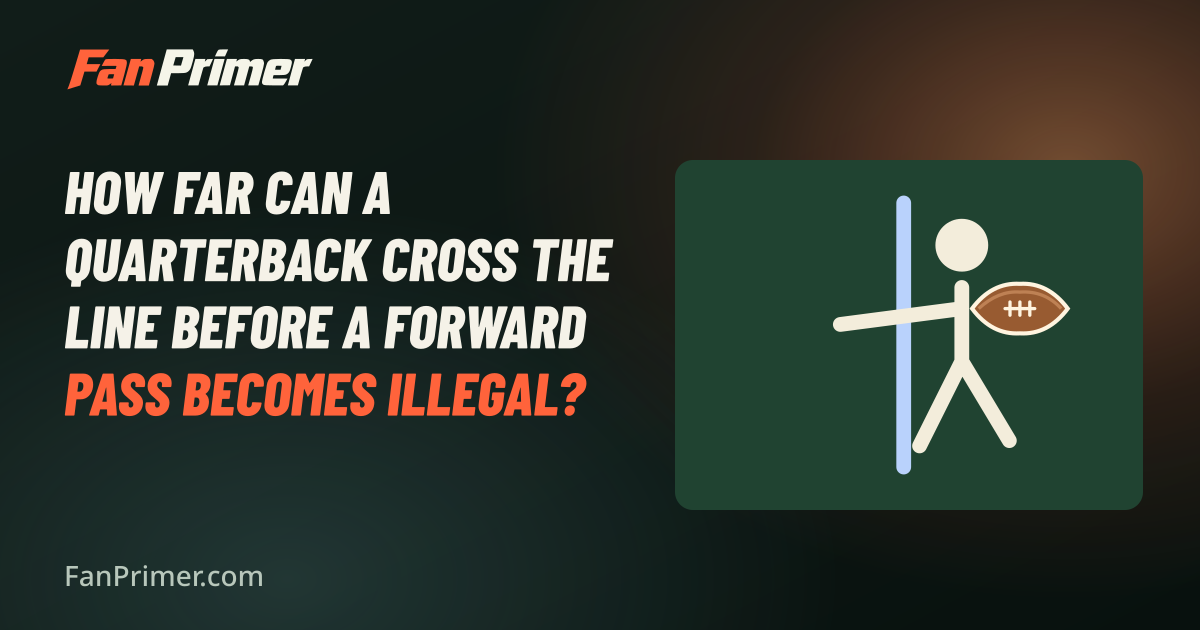
A quarterback may throw forward while any part of his body or the ball remains behind the starting line, unless the ball already crossed and returned.
See how it works
One arm still behind
Feet alone do not decide this boundary.
Entire body and ball beyond
The passer and ball have both completely crossed at release.
Cross out, then come back
A carried ball that already crossed the line cannot be brought back for a legal forward pass.
Check the instant the pass is released
For this rule, the line of scrimmage is a vertical plane through the forward tip of the ball at the start. A passer is beyond it only when his whole body and the ball are beyond it at release. Jumping into the air does not avoid that test.
Feet alone cannot settle the question
The quarterback's feet may cross while a trailing arm remains behind the plane. That throw can still be legal. In the comparison, the second passer's whole body and the ball have cleared the line. His forward pass is illegal. Use the release moment, rather than where he later lands.
Crossing and coming back is different
Suppose the play begins at the 40. The ball crosses to the 42, then comes back to the 39. The offense cannot regain its permission to throw forward by retreating. A picture of the release behind the line would miss the earlier crossing.
What counts as the ball crossing
For this restriction, an offensive fumble, pass or legally kicked ball crosses when it touches the ground, a player or an official beyond the neutral zone around the starting ball. Briefly flying over the line without that contact is not by itself enough under this test.
Both illegal throws use up the try
A forward pass released beyond the line carries 5 yards from the release spot and loss of the try. A pass after the ball crossed and returned carries 5 yards from the previous starting spot and loss of the try. An opponent may intercept and advance an illegal pass, then decline the penalty. The relevant line judgment is reviewable.