Season & playoffs
Why can an NFL team host a playoff opponent with a better record?
The takeaway
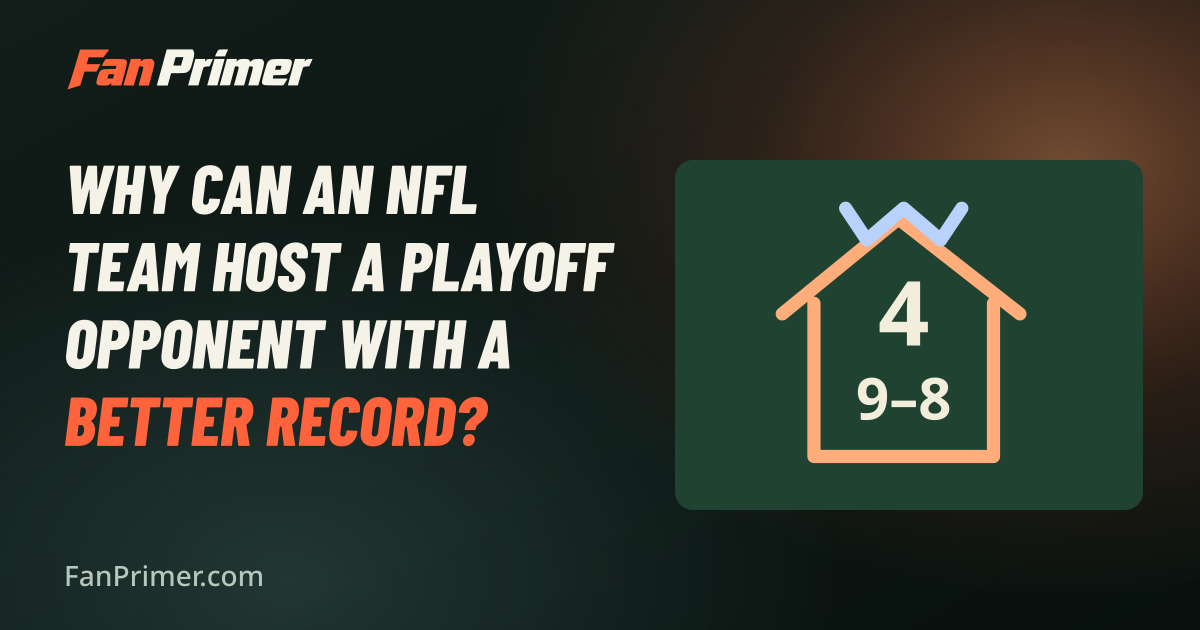
Division winners get the top four playoff positions in each conference. A wild card can therefore visit a division winner that won fewer regular-season games.
See how it works
One fictional conference · 17 games per team
First, the 4 division winners
- 1Owls13–4
- 2Foxes12–5
- 3Oaks11–6
- 4Sparks9–8
Then the 3 wild cards
- 5Comets12–5
- 6Waves11–6
- 7Lynx10–7
Sparks hosts. Winning a division puts its 9–8 record in the first group. The 12–5 wild card starts in the second group.
Winning a division puts a team in the first group
Each conference sends 4 division winners and 3 wild cards. Division winners fill positions, or seeds, 1–4, ordered by winning percentage and tiebreakers. Wild cards fill 5–7. A wild card's better record cannot move it into the division-winner group.
Position 4 hosts position 5
The Sparks finish 9–8 but win their division. The Comets finish 12–5 behind the Owls elsewhere. Sparks take seed 4 and Comets seed 5. The opening round sends 5 to visit 4, so Sparks host. Seeds 2 and 3 also host; seed 1 skips the round.
Different records do not need a tiebreaker
Nine wins and 12 wins are not tied. Their division-winner and wild-card status puts them in different groups before records order each group. Tiebreakers help settle equal percentages within those groups; they do not remove that grouping.
An upset does not change the seed
A wild card keeps its original seed after winning. Later pairings and home-field decisions still use the remaining seeds. A better regular-season record alone does not override those positions in a later round.