Scoring & kicking
Who can recover and run with a blocked punt?
The takeaway
Either team can pick up a blocked punt. Whether the kicking team can keep it or run with it depends on where it recovers and who touched it.
See how it works
Recovery behind scrimmage: a run is available
Fourth-and-4 at the 40 still means reaching the 44. Merely recovering the blocked kick does not refresh the downs.
Block near scrimmage, recovery beyond it
A block attempt in the immediate vicinity of scrimmage is disregarded as a receiver touch. A kicking-team recovery beyond the line ends the play.
A separate receiving-team touch downfield
This touch lets the kickers keep a downfield recovery. The recovery stops play and starts a new series.
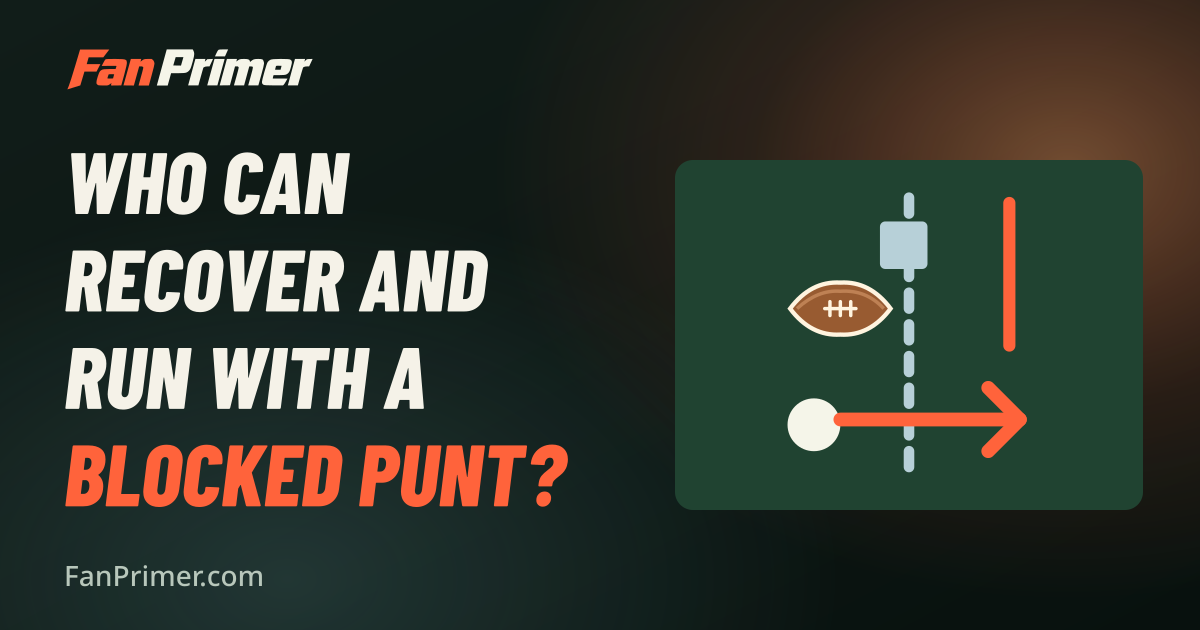
Cream: kicking team · Blue squares: receiving team · Blue dashed: scrimmage · Orange: first-down target
First, find the starting line
A blocked punt is already in play; the block does not make a dead ball live. A kicking teammate recovering behind the line where the play began may run. This also applies if the ball crossed that line and bounced back. The receiving team can ordinarily recover and return on either side, unless another rule, such as a fair-catch signal, stops the return.
A pickup alone may not earn fresh tries
Start on 4th try at the kicking team’s 40, needing 4 yards. A teammate picks up the blocked punt at the 35. If the receiving team has not touched it beyond the starting line, he still needs to reach the original target at the 44. Finishing at the 42 is short, despite running 7 yards after the pickup. Reaching the 46 earns a first down.
A block near the line does not open every recovery
When a receiver tries to block the kick right around the starting line, that touch does not count for the rule allowing the kickers to keep a later downfield pickup. If the ball continues beyond the line and a kicker recovers there, the receiving team gets it. Not every defensive fingertip gives the kickers recovery rights.
A later receiving-team touch can change the result
If a receiving player touches the punt beyond the line, outside that near-line-block exception, the kickers may keep a later recovery downfield. Their pickup immediately ends play, so they cannot run it in for a touchdown. If that touched kick comes back behind the starting line, they may recover and run there, earning fresh tries even short of the old target.
A receiver catching and then dropping it is different
These restrictions concern a ball still classified as a kick. Once the receiving team gains possession and then drops it, it is a fumble. A kicker recovering that opponent’s fumble may ordinarily run. Check where the ball is recovered, whether a qualifying receiver touch occurred, and whether anyone already possessed it.