Scoring & kicking
Why do teams punt in football?
The takeaway
A punt usually gives the opponent the ball farther from your goal. Your team gives up another attacking chance to make the opponent’s next attack harder.
See how it works
Drop the ball, then kick it
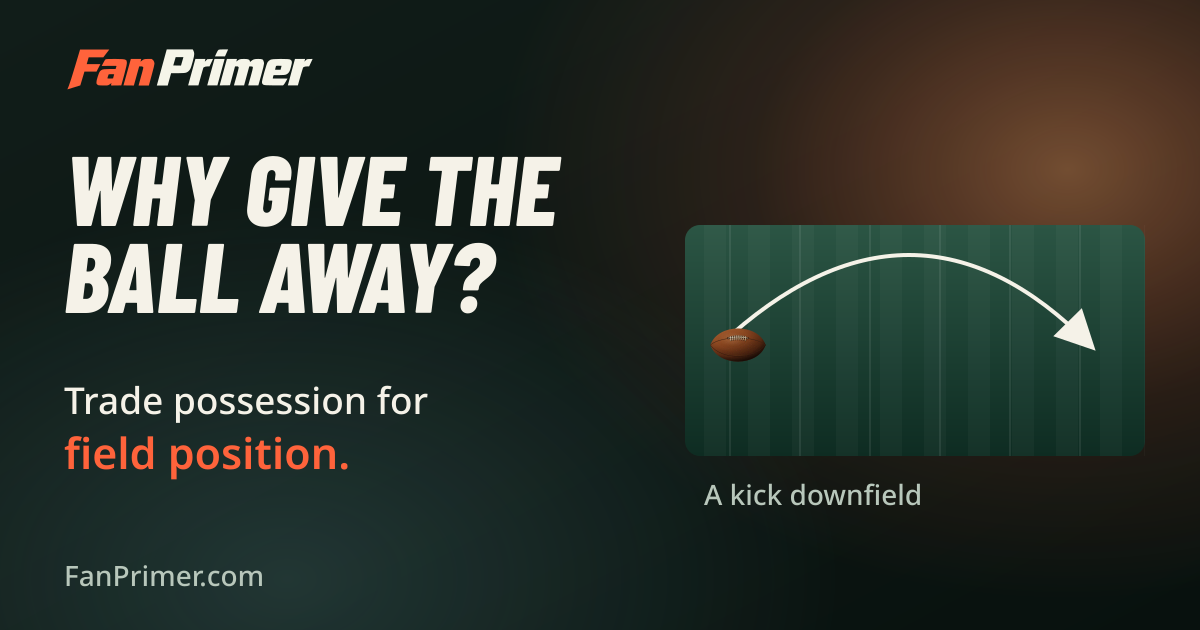
The punter kicks the dropped ball before it touches the ground. A punt aims for territory.
Failed 4th down · no gain
30 yards to Team A’s goal line
Punt · no return
70 yards to Team A’s goal line
The punter drops and kicks the ball
He receives a long backward snap, drops the football and kicks it before it reaches the grass. A punt aims to move the opponent’s next starting place farther away, rather than score like a field goal. Teams most often choose it on 4th down when gaining the needed yards or scoring looks difficult.
Compare where the opponent would start
Team A is at its own 30 on 4th try, needing 8 yards. A run or pass gaining nothing lets Team B start only 30 yards from A’s goal. After this punt, B starts at its own 30, 70 yards from A’s goal. Both choices give up possession; the difference is how far B must now travel.
A long kick does not add points
The kick changes the opponent’s likely starting spot. It does not score points just by traveling downfield. Passing the first-down target with a punt also does not earn the kickers fresh tries in this ordinary example.
Wait for the return to finish
If B returns this punt 15 yards, its remaining distance to A’s goal shrinks from 70 to 55. A fair catch gives up the return, and a punt secured by the kickers ends it too. Judge the opponent’s final starting spot, not merely where the kick arrived.
A fair catch and touchback change the trade
A fair-catch signal gives up running after the catch in exchange for protection there. A punt touchback normally starts at the receiving 20, so a kick into the end zone can lose some of the ground the punter hoped to gain. Kickoff touchback placement is different.