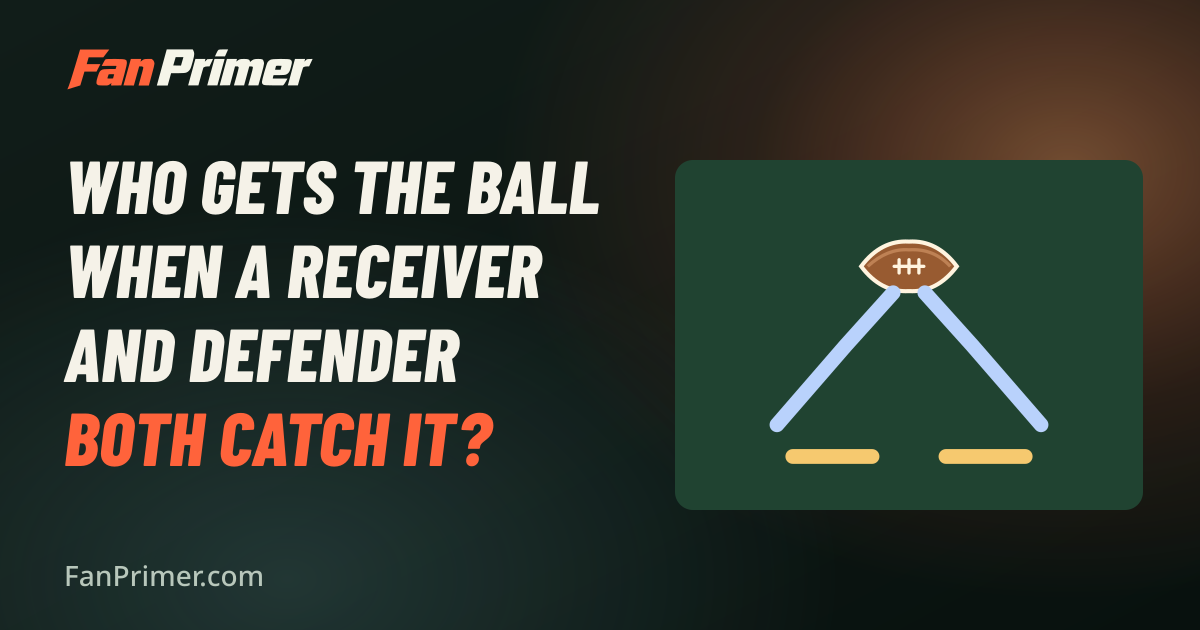
Downs & possession
Who gets the ball when a receiver and defender both catch it?
The takeaway
If a receiver and defender truly catch the pass together, the passing team keeps it. Grabbing a ball the defender already controls does not create a tie.
See how it works
Control begins together
When control begins together and the catch is finished, the passing team keeps the ball.
Defender controls first
The receiver’s later grip cannot create a simultaneous catch.
Who gained control first?
When eligible opponents catch a forward pass at the same time and both keep it, the passing team gets the ball. But a receiver cannot create a tie by grabbing a ball the defender already controls. Officials judge when control began, not just who has hands on it at the end.
Compare the two catches
In the first picture, both players control the ball together, land inside the field and finish the catch while keeping their shared grip. The offense keeps it. In the second, the defender controls it before the receiver grabs it. If that defender finishes the catch and keeps control, it is an interception: the defense has won the ball.
Touching first is not the same as controlling first
A fingertip, slap or bobble can touch the ball without securing it. The important question is whether one player controlled it before both held it. A photo taken after both players’ hands arrive cannot always show that order.
Both players still need to finish a catch
Holding a pass while airborne is not enough. A catch also needs the required contact inside the field and a normal football action, or control long enough for one. If nobody finishes a catch and the forward pass hits the ground, there is no catch to award. If it stays airborne after a touch, someone may still catch it.
The end zone does not remove the catch requirements
A truly shared catch completed in the opponent’s end zone can give the offense a touchdown. An unfinished catch or contact out of bounds does not become a score. A fumble held simultaneously generally goes back to the team that last possessed it; kicks use a separate receiving-team rule.