Foundations
How do you read an NFL scoreboard?
The takeaway
Find who leads and who has the ball. Then check the time left and the team’s current try: those numbers explain what it needs next.
See how it works
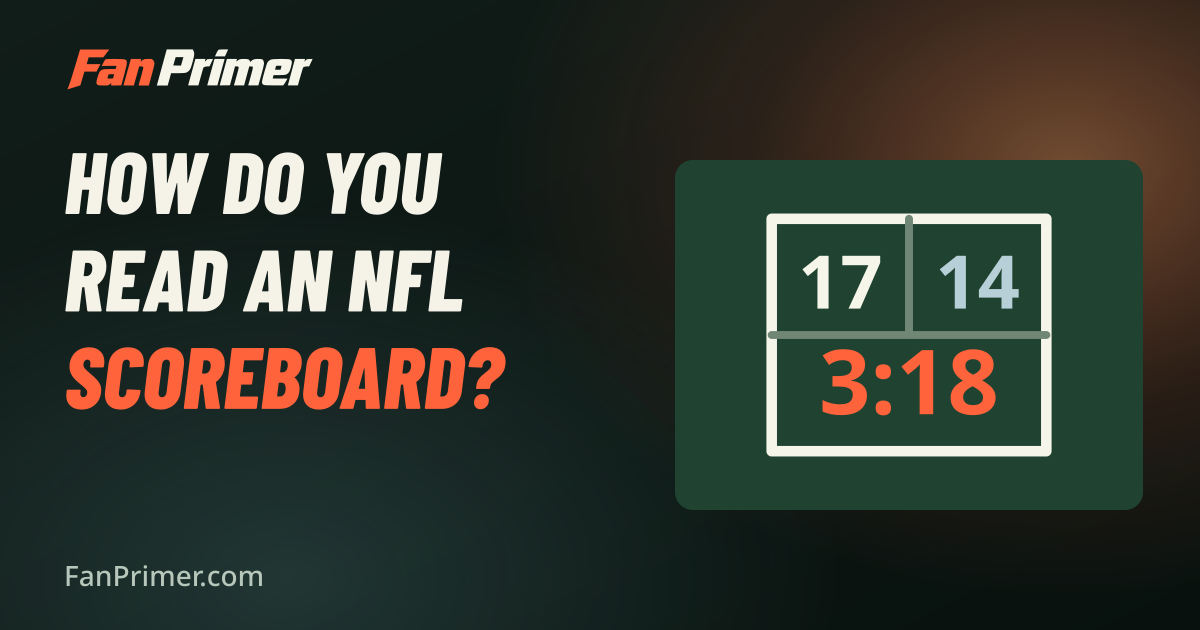
- 17–14
- Points scored. Owls lead by 3.
- Q4 · 3:18
- 4th quarter, 3 minutes 18 seconds left.
- 3rd & 6
- The offense’s 3rd try; 6 yards to earn fresh tries.
- :12
- 12 seconds to start the next play.
- ●
- The dot beside Owls means they have the ball.
Invented teams and an original teaching display. Real broadcasts arrange these fields differently.
Start with score and possession
The Owls lead 17–14. The dot beside their name means they have the ball. Some broadcasts use a small football instead. The marker shows possession; it does not add a point or show where the ball sits on the field.
The clocks count different things
“Q4” and “3:18” mean 3 minutes 18 seconds remain in the 4th quarter. The separate play clock’s “:12” means 12 seconds remain to start the next play. The game clock can run or stop between plays; the play clock limits the wait for the next snap.
Read “3rd and 6” as a task
It means the offense is on its 3rd try and needs 6 yards to earn fresh tries. It usually does not mean 6 yards to score. Gaining 4 normally leaves 4th try with 2 needed. Gaining 6 normally earns a new set. Penalties can also change those numbers.
Smaller symbols vary by broadcaster
Marks beside a team often show how many of its 3 timeouts for that half remain. A flag or replay-review notice may temporarily cover the try and distance. Read the labels: colors and layouts vary. A yellow penalty notice is different from the orange first-down target in these diagrams.
Put the numbers together
The Owls lead by 3 late in the game and face their 3rd try with 6 yards needed. Keeping the ball and letting time pass can help them. A trailing team would care more about saving time and scoring. The score, clock and current try help explain the decision together; no one number decides it.