Offense & play design
What do receiver cushion and separation actually measure?
The takeaway
Cushion measures a receiver's gap from his defender at the snap. Separation measures the nearest defender's gap when the targeted pass ends in a catch or incompletion.
See how it works
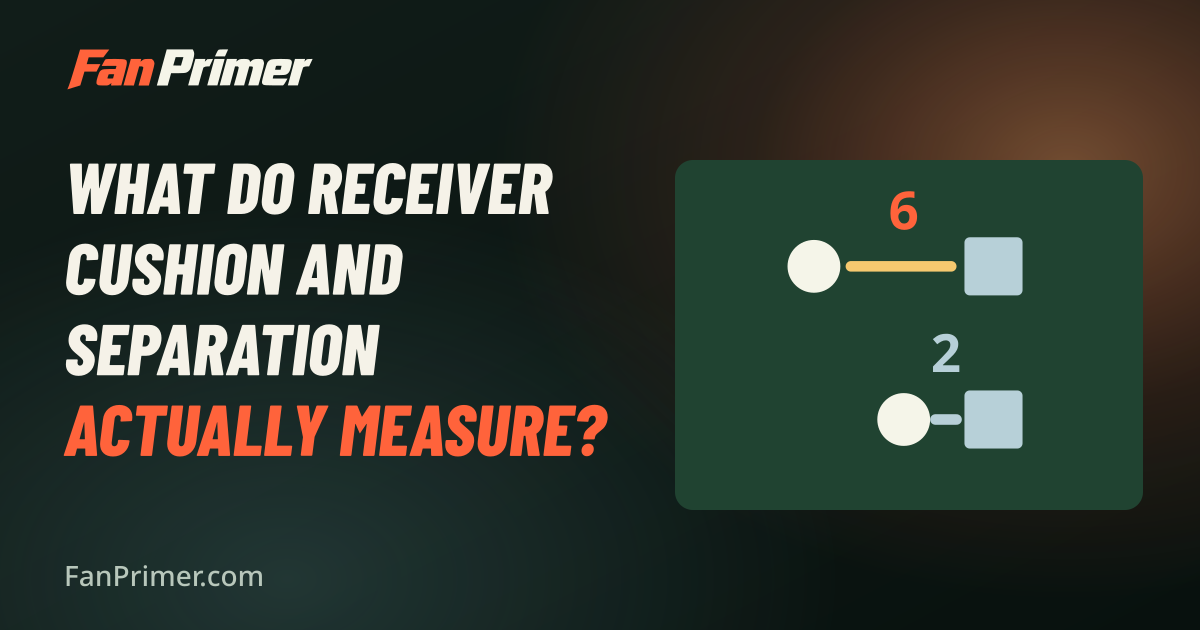
Snap: starting gap
R is lined up against A, 6 yards away. On this targeted play, that supplies the cushion sample.
Catch: nearest defender
At the catch, A is 5 yards away but B is only 2. The separation sample uses B, even though A supplied the starting cushion.
Cream circle R: receiver. Blue squares A and B: two defenders. Gold: the gap used at that timestamp. Both panels use the same field scale.
The numbers measure different moments
Cushion is the distance between a targeted receiver and the defender lined up against him when the ball is snapped. Separation is the distance to the nearest defender when the pass is caught or becomes incomplete. That nearest defender may be someone else. Neither number measures the whole route.
An average combines particular samples
Here, the receiver starts 6 yards from A and catches 2 yards from B. Those are two measurements from one pass aimed at him. If three targets produce separation readings of 2, 3 and 4 yards, the average is 3. That does not mean he stayed 3 yards open. A route with no target adds no sample to this target-based measure.
Distance alone does not identify the cause
A gap does not tell you which defender was responsible, what coverage the defense used, how well the receiver ran, or how difficult the throw was. These statistics describe distances at defined moments. More context is needed to judge why those gaps appeared or how well someone played.