Season & playoffs
How does NFL playoff reseeding change the next matchup?
The takeaway
After the opening round, the highest-ranked team hosts the lowest-ranked survivor. The other two survivors meet at the higher-ranked team's stadium. Original seed numbers stay unchanged.
See how it works
One conference · Original seeds stay attached
Choose each Wild Card winner.
Survivors in seed order
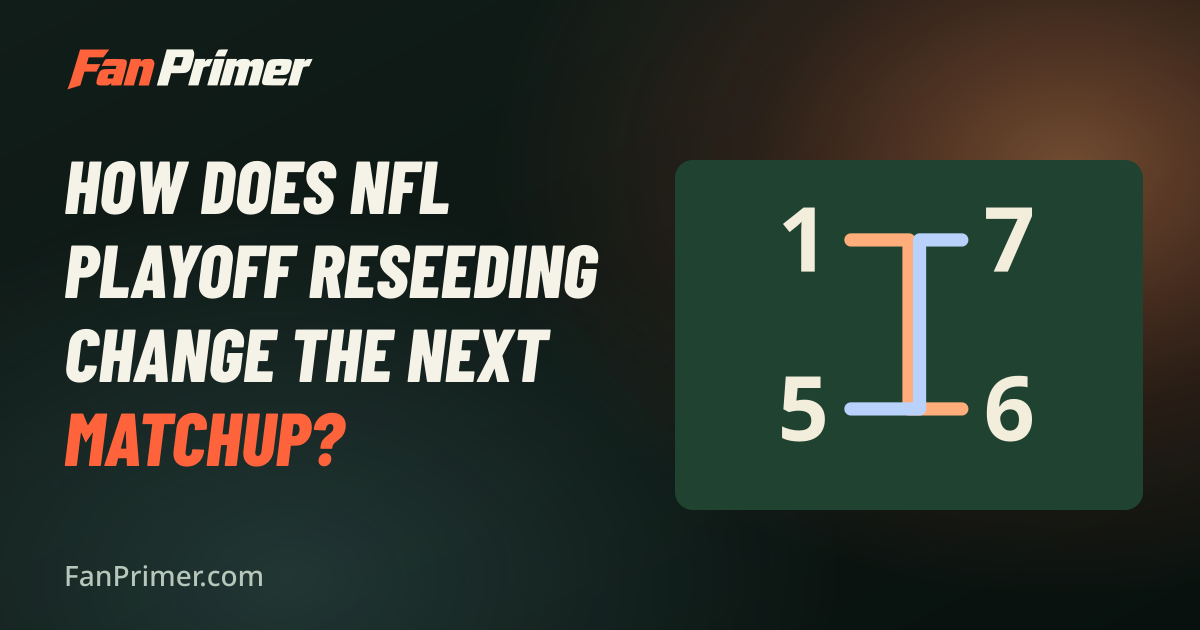
Seed 1 hosts 7. Seed 5 hosts 6.
All 8 possible combinations
| Winners | At seed 1 | Other game |
|---|---|---|
| 2, 3, 4 | 1 hosts 4 | 2 hosts 3 |
| 2, 3, 5 | 1 hosts 5 | 2 hosts 3 |
| 2, 6, 4 | 1 hosts 6 | 2 hosts 4 |
| 2, 6, 5 | 1 hosts 6 | 2 hosts 5 |
| 7, 3, 4 | 1 hosts 7 | 3 hosts 4 |
| 7, 3, 5 | 1 hosts 7 | 3 hosts 5 |
| 7, 6, 4 | 1 hosts 7 | 4 hosts 6 |
| 7, 6, 5 | 1 hosts 7 | 5 hosts 6 |
Smaller numbers mean higher positions
Each conference has seeds 1–7: four division winners followed by three wild cards. Number 1 skips the opening round. Number 2 hosts 7, 3 hosts 6, and 4 hosts 5.
Sort the remaining teams for the next round
After those games, seed 1 joins the three winners. Match the smallest original number against the largest. The two others form the second Divisional matchup. In each, the smaller number hosts. The next opponent therefore depends on which teams survived.
An upset changes the matchup, not the seed
If 7 beats 2 while 3 and 4 win, the next games are 7 at 1 and 4 at 3. The winner of the upset remains seed 7. If all visitors win, the survivors are 1, 5, 6 and 7: 7 visits 1, and 6 visits 5.
The conference final uses the same priority
The two Divisional winners play at the smaller original seed's stadium. AFC and NFC follow this process separately, and division rivals may meet. The Super Bowl's home-team designation follows a different arrangement; it does not award the game to the smaller seed's stadium.