Penalties & rulings
How is a legal stiff-arm different from a facemask or hands-to-the-face foul?
The takeaway
A runner may use an arm to ward off a tackler. Gripping or moving the face mask, or illegally forcing a blocker's hand into the face, changes the ruling.
See how it works
Check the role and the hand’s action
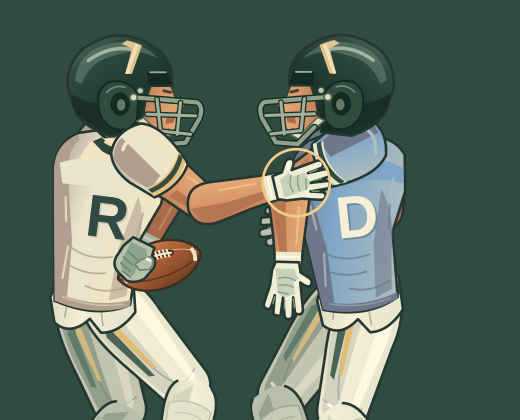
Open hand on the shoulder
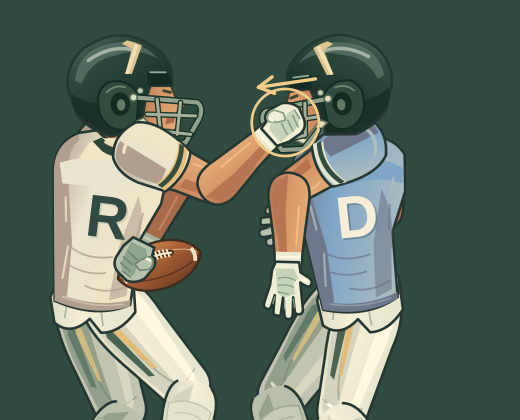
Fingers control the facemask
A blocker strikes the head
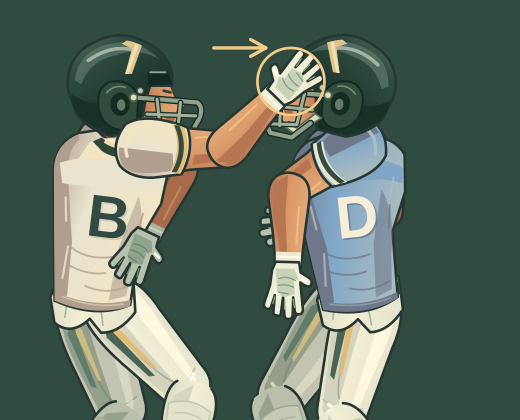
Cream: offense · Blue: defender · Gold: contact or control
A runner can push a tackler away
A stiff-arm is a runner using a hand or arm to keep a defender away. That permission belongs to the ball carrier in that action. It does not give a teammate blocking for him permission to hold an opponent.
An open hand is not always legal
A player cannot grip the face mask or a helmet opening to control an opponent, or twist, turn, push or pull the mask illegally. A player who grips it must release immediately. A runner using an open palm can still foul if he illegally moves the mask.
Blockers have a separate hands rule
When blocking, a player cannot thrust his hands forward above the opponent's body frame to deliver forceful or prolonged head or neck contact. This can be illegal hands to the face without anyone hooking a finger into the mask. The body frame presented to the opponent is below the neck.
Follow the hand's action
Owl carries the ball and places a palm on Fox's shoulder to fend him off: that can be legal. Hooking a face-mask bar and pulling Fox's head is a face-mask foul. A blocker forcing a hand into Fox's face can commit illegal hands to the face even without gripping a bar.
The penalties depend on the foul
A face-mask foul costs 15 yards; against the defense it also awards a fresh first try, and flagrant conduct can cause ejection. Illegal hands to the face costs the offense 10 yards, or the defense 5 yards plus a fresh first try. Judge the role and action rather than relying only on a commentator's label.