Downs & possession
What makes a pass a lateral, and why does dropping it keep the ball live?
The takeaway
A sideways or backward pass can still be picked up after it hits the ground. Dropping one can let the other team win the ball.
See how it works
Forward
Forward initial travel, or first contact ahead, makes a forward pass.
Level: a backward pass
The ball starts level or backward and first touches level with or behind release.
Backward
The ball starts level or backward and first touches level with or behind release.
“Lateral” usually means a sideways or backward throw
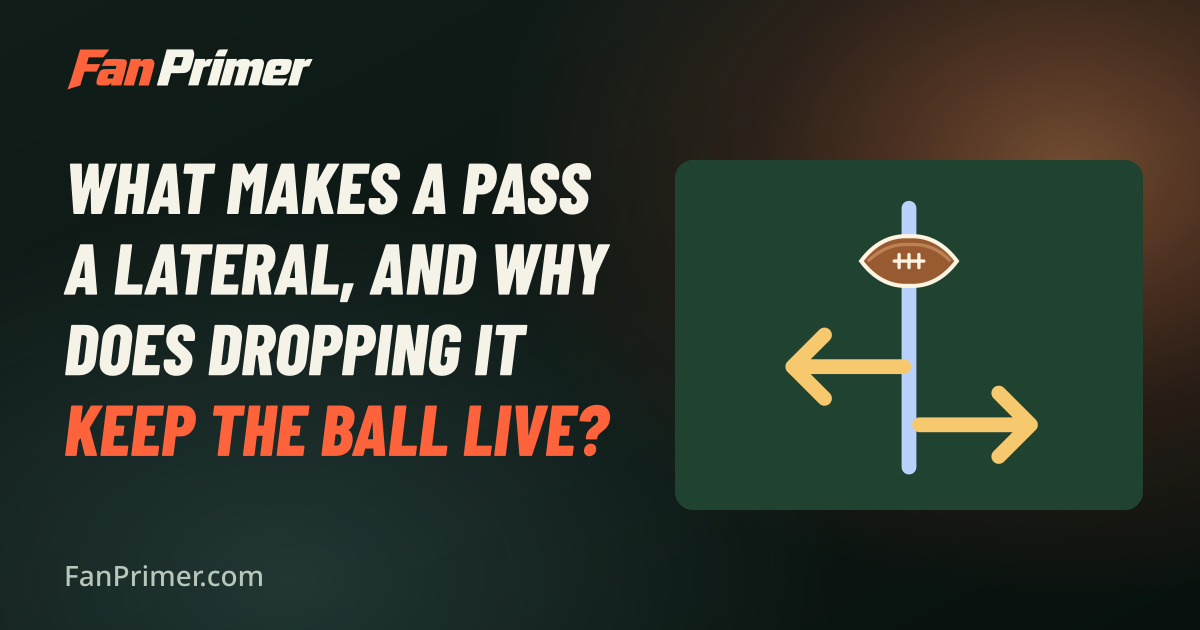
The NFL treats a throw straight across the field as a backward pass too. Compare its movement with the yard lines and the opponent’s goal. The direction the passer happens to face does not decide whether the pass went forward.
Compare where it leaves with where it first arrives
All three throws leave at the 40. One travels toward the 41, one straight across at the 40, and one toward the 39. An uncaught forward pass ends play when it hits the grass. The level and backward throws can keep bouncing and remain available to recover.
Either team still needs to secure the ball
A bounce does not automatically give the defense possession. Either team can catch a backward pass or pick it up and run, subject to the normal ways a play ends. A runner can throw backward after going beyond the starting line. It need not be a quarterback throwing from behind the line.
A tip does not change the kind of pass
A ball that starts forward remains a forward pass even if it later reaches a point behind where it was thrown. Once established, its forward or backward status does not change because of a tip or other deflection. A forward pass tipped backward onto the grass is still incomplete. A backward pass tipped forward may still be recovered.
A dropped lateral can cost possession
Dropping a legal forward pass ends the play and returns the ball to the starting spot. Dropping a backward pass can leave the opponent a chance to take it. If a backward pass goes out of bounds, the play ends; that differs from a ball still bouncing inside the field.