Scoring & kicking
What changes when a punt returner signals for a fair catch?
The takeaway
A clear fair-catch signal gives up the return when the punt is caught. It adds protection after the catch, but a bobble can still cost the ball.
See how it works
No signal · a return is available
The receiver has a protected chance to catch the airborne punt, then can run and be tackled.
Valid signal · catch ends the play
A full arm wave above the helmet gives up the return and protects the catcher from unnecessary contact.
A muff can give the kickers the ball
The ball hits the ground after R’s failed catch. K can recover it; the signal does not award R the ball.
Cream: receiving player R · Blue: punt coverage K
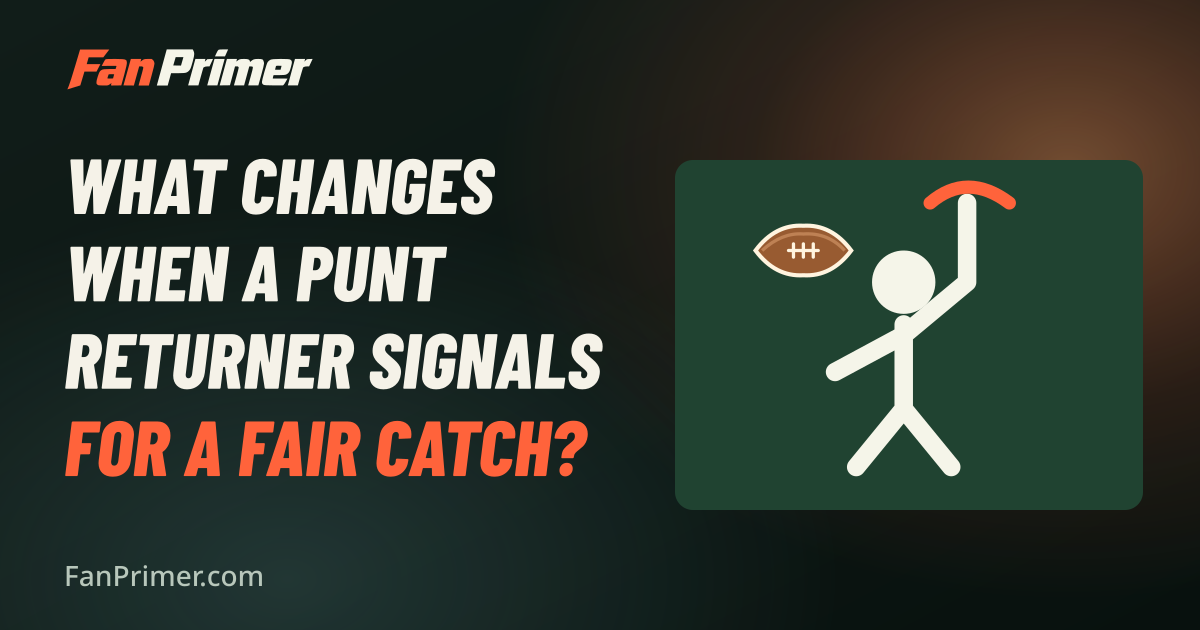
The signal is a full overhead wave
While the punt is airborne, the receiver fully extends one arm above his helmet and waves it side to side. A different raised-hand gesture may be an invalid signal costing 5 yards. Raising a hand alone is not a reliable substitute.
Catching ends the return
Without a signal, a receiver can ordinarily run after controlling the punt. With a valid signal, the signaling player’s catch ends play immediately. He gives up return yards for protection against unnecessary contact after the catch. Incidental contact is not automatically a foul.
A chance to catch exists even without waving
Coverage players must leave an unobstructed chance to catch a catchable airborne punt beyond the starting line. That basic protection does not depend on a fair-catch signal. The signal adds restrictions after the catch.
A signal does not guarantee keeping the ball
If the signaling receiver touches but does not control the punt, he still gets a reasonable chance to catch it before it hits the ground. Once it lands, the kickers may recover, ending play. A receiver recovering first normally ends play too. Receiving players may advance if a kicking player has touched the ball.
The receiving team then chooses its next play
After a completed fair catch, the team can start an ordinary play at the catch spot or attempt a fair-catch kick from there. The signal itself adds no points or yards. It also limits the signaling player’s right to block before another player touches the ball.