Scoring & kicking
Why can touching a kickoff with one foot out of bounds change the ruling?
The takeaway
A kickoff touching a player with a foot on the sideline is out of bounds too. With no earlier receiving-team touch, that can trigger the kickoff penalty.
See how it works
Touch with inbounds feet
The ball can still be caught or recovered and returned. If R touches it inbounds and it later exits, the receivers get the ordinary out-of-bounds spot.
Touch while grounded out of bounds
No earlier receiver touch: the kick is ruled out of bounds. From an unadjusted kicking 35, the 25-yard penalty option puts the receivers at their own 40.
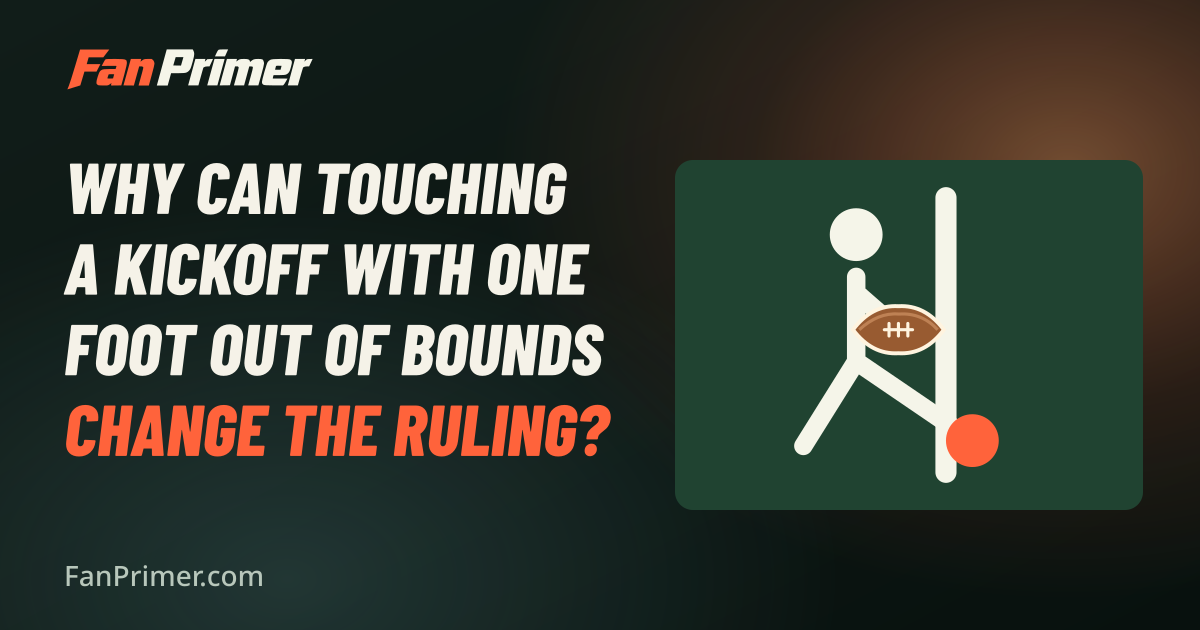
Cream R: receiving player · Gold circle: grounded foot
A player outside the field can make the ball out too
Touching the sideline or ground outside it makes a player out of bounds. A loose kickoff touching him is then out as well, even if the ball itself is still above the field. That lets a returner stand on the boundary and reach inward toward the ball.
The grounded foot changes the result
An untouched kickoff bounces near the sideline at the receiving team’s 8. Touch it with both feet inside and it is an inbounds receiver touch. Put one grounded foot on the sideline before touching the same ball and the ball becomes out at contact. Merely holding a foot in the air outside while standing inside does not have the same effect.
A normal kick from the 35 can give a choice at the 40
With no earlier inbounds receiver touch, this out-of-bounds kickoff gives the receiving team a placement option 25 yards ahead of the kick spot. From the kicking team’s 35, that is 15 yards to midfield plus 10 more to the receiving team’s 40. It is an option, not an automatic own-40 start for every kick. A penalty moving the kick spot changes the calculation.
The team may also choose where the ball went out
The receiving team can instead take the out-of-bounds spot. In the own-8 example, the own-40 option is much farther forward. The next snap moves to the near hash at the chosen yard line. A free kick after a safety uses a different option, 30 yards from its kick spot, rather than this ordinary kickoff calculation.
An earlier inbounds touch matters
If the returner first touches the kick while inside and it later goes out, his team ordinarily starts at the spot corresponding to that exit. Stepping out afterward does not undo the earlier touch or make it an untouched kickoff out of bounds. Check the order of the foot contact and ball contact.