Downs & possession
What counts as a completed catch in the NFL?
The takeaway
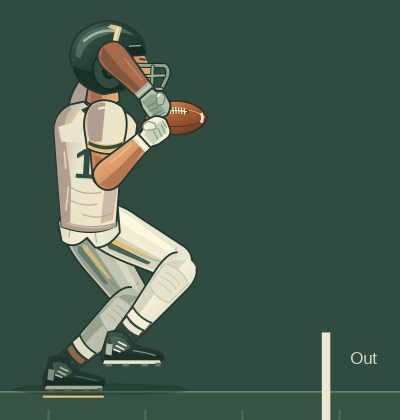
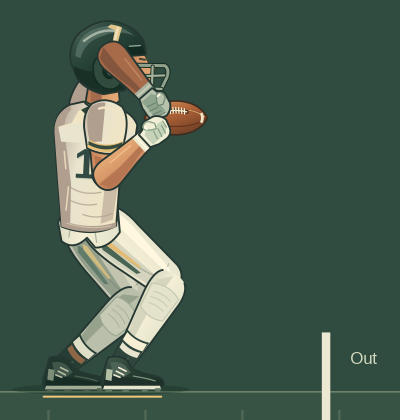
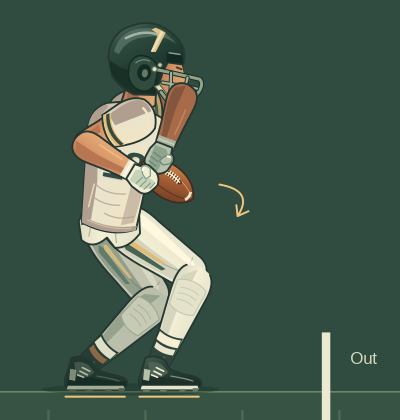
A receiver must control the ball, land inside the field, and finish a football action—or hold it long enough to do one. Two feet alone are not enough.
See how it works
One receiver completes all three requirements
1 · Control before the ground
2 · Both feet inbounds
3 · Tuck and turn
A catch has 3 parts
First, control the ball before it touches the ground. Then touch inside the field with both feet, or a body part other than the hands. Finally, make a normal football action or keep control long enough to do one. Tucking and turning, taking another step, or reaching with the ball can supply that final part.
Both feet means two different feet
Dragging a toe can count as contact inside the field. Touching twice with the same foot does not count as both feet. A knee can satisfy the ground-contact requirement instead. The boundary itself is out: a normal step that continues from toe to heel onto the boundary can make that foot out of bounds.
A receiver still finishing the catch must keep control on landing
If he has control and the required inbounds contact but has not finished the last part, losing the ball as he lands can mean no catch. That applies if it touches the ground before he regains control. Losing it after completing all 3 parts can instead be a fumble.
The ball touching grass does not always erase the catch
The ball may touch the ground if the receiver keeps control. A little movement does not automatically prove he lost control, either. Officials have to watch the whole sequence. One image of a ball near the grass cannot settle every catch.
Catching in the end zone uses the same test
The receiver must still finish a catch in the end zone to score. A runner already holding the ball can score by reaching the goal line, but a pass touching a receiver’s hands across that line is not by itself a touchdown.