Scoring & kicking
When is a ball in the end zone a safety or a touchback?
The takeaway
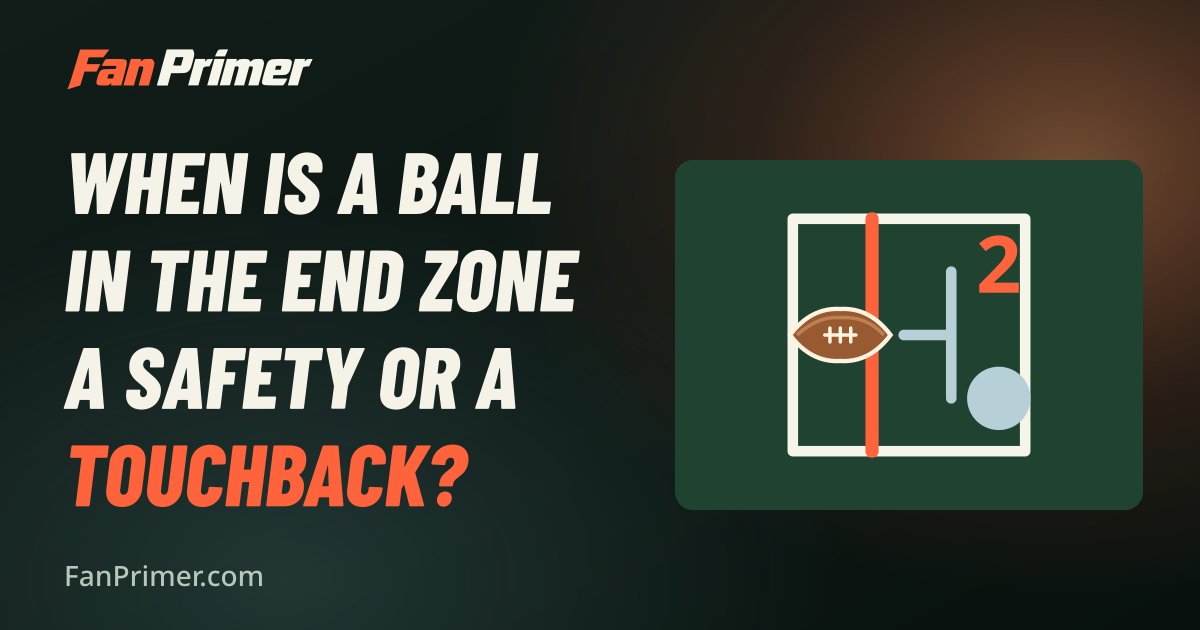
Ask who sent the ball into the end zone. A touchback gives possession without points; a safety gives the opponent 2. Momentum and other exceptions can change the result.
See how it works
Opponent sends the ball in
R intercepts in the end zone and kneels there. Touchback: no points; R’s team gets the ball at its 20.
R stops, then retreats into it
R catches at the 2, stops, then runs backward and is tackled in the end zone. Safety: 2 points to the opponent.
Original momentum carries R in
R catches at the 2 and cannot stop before entering the end zone. With no foul, the momentum exception returns the ball to the 2.
Cream R: team defending this end zone
Who supplied the force that sent it in?
The rule calls that force impetus. A pass, kick, snap, fumble or runner carrying the ball can supply it. A later touch of a loose ball does not always replace the earlier force. Batting a grounded ball, illegally kicking it, or bobbling a ball at rest or nearly stopped can supply new force.
A touchback gives the defender the ball
R catches the opponent’s pass in R’s own end zone and kneels. The opponent sent the ball in, so R’s team gets a touchback at its own 20, with no points awarded. Punt touchbacks also use the 20. Kickoff and safety-kick touchbacks have separate placement rules.
Taking it back yourself can concede a safety
R controls the ball at the 2, stops, retreats into his own end zone and is tackled. His own carry brought it there, so the opponent scores 2. R’s team must then free-kick from its own 20. An offensive foul applied behind its own goal line can also produce a safety.
Being carried in by original momentum is different
R gains possession at the 2, and his original movement carries him into the end zone, where play ends with his team still possessing it. With no foul, the ball returns to that original possession spot rather than producing a safety. That differs from stopping and choosing to retreat. A qualifying spot inside the 1 is placed at the 1.
Being in an end zone does not settle every case
An incomplete forward pass there is neither a safety nor a touchback. A possessed ball reaching the opponent’s goal line may instead score a touchdown. Identify whose end zone it is, what sent the ball there, and who possesses it when play ends.