Scoring & kicking
What makes a lead a one-score or two-score lead?
The takeaway
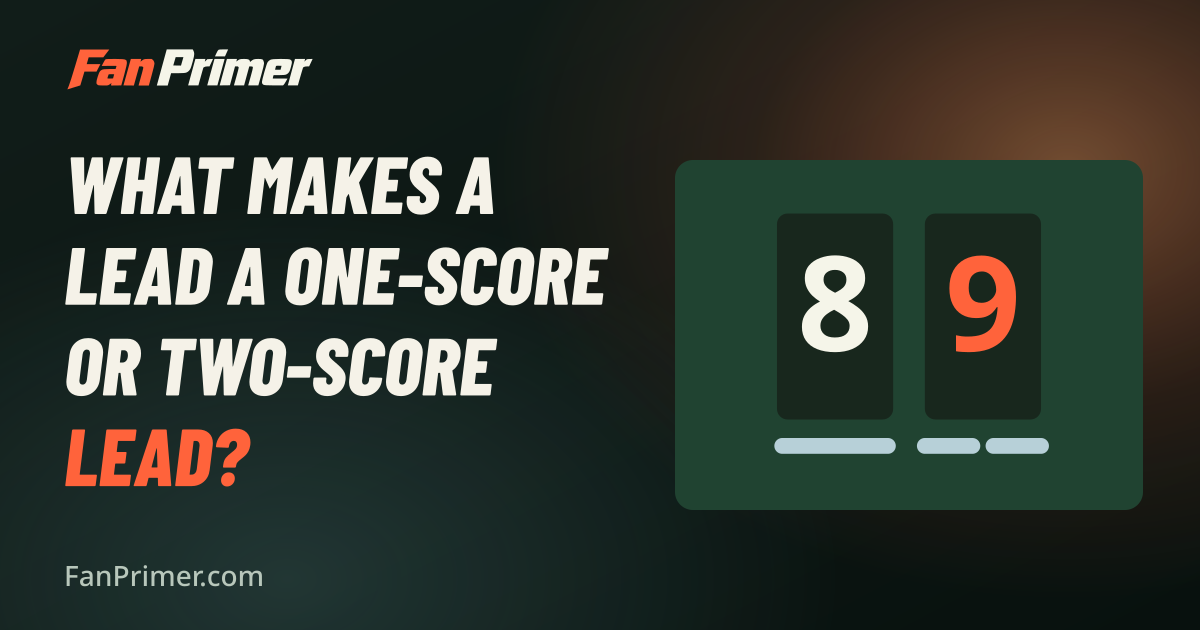
One touchdown plus its extra attempt can add up to 8 points. A lead of 9 to 16 therefore takes at least two such scoring opportunities to erase.
See how it works
A touchdown and its try form one bundle
Calling a gap “one score” counts the touchdown and its following try together.
8 can tie; 9 needs more
The leader scores nothing else. Adding the same 8 points erases one gap but leaves the other unfinished.
The combination changes the plan
These are possible totals, not guaranteed scores. A successful try is part of each 7- or 8-point bundle.
“One score” bundles a touchdown with its extra attempt
A touchdown earns 6. A successful kick afterward adds 1, while a successful run or pass adds 2. The bundle can total 7 or 8; a failed extra attempt leaves 6. They are separate plays, but comeback talk often counts the bundle as one score.
Erasing the lead may only tie the game
Down 3, a field goal ties. Down 7, a touchdown and successful extra-point kick tie. Down 8, the team needs a touchdown and successful 2-point attempt to tie. At 24–16, adding 8 reaches 24–24. At 24–15, it reaches only 24–23. That extra point of deficit means another score is needed.
Not just any two scores will work
A 10-point gap can be tied with 3 + 7. Two touchdowns and two extra-point kicks total 14. To erase 16 with two touchdown drives, each needs 8. A 9-point gap could be tied with a field goal and touchdown without a successful extra attempt; 10 points would take the lead. The label describes the task, not a guarantee that any two scores suffice.
Check how many chances remain
These examples hold the opponent’s score still and use field goals or touchdowns with extra attempts. They do not promise enough time, two possessions or successful conversions. Defensive scores, safeties and unusual extra-attempt outcomes can produce other sequences. “Two scores” is useful shorthand, not a separate scoring rule.