Penalties & rulings
Why can a block to the chest still be an illegal blindside block?
The takeaway
A chest hit can still be a blindside foul. Check whether the blocker moves toward or parallel to his own end line and delivers a forceful prohibited blow.
See how it works
Outside close-line play · The blocker’s own end line is to the right
Same travel direction and contact area, different action
Force the shoulder into the chest
The blocker travels toward his own end line and delivers a forcible shoulder block. Contact to the opponent’s chest still satisfies the blindside test here.
Hands meet the body
The blocker travels in the same direction but makes ordinary hand contact below the neck, without the prohibited forcible helmet, forearm or shoulder blow. Other blocking rules still apply.
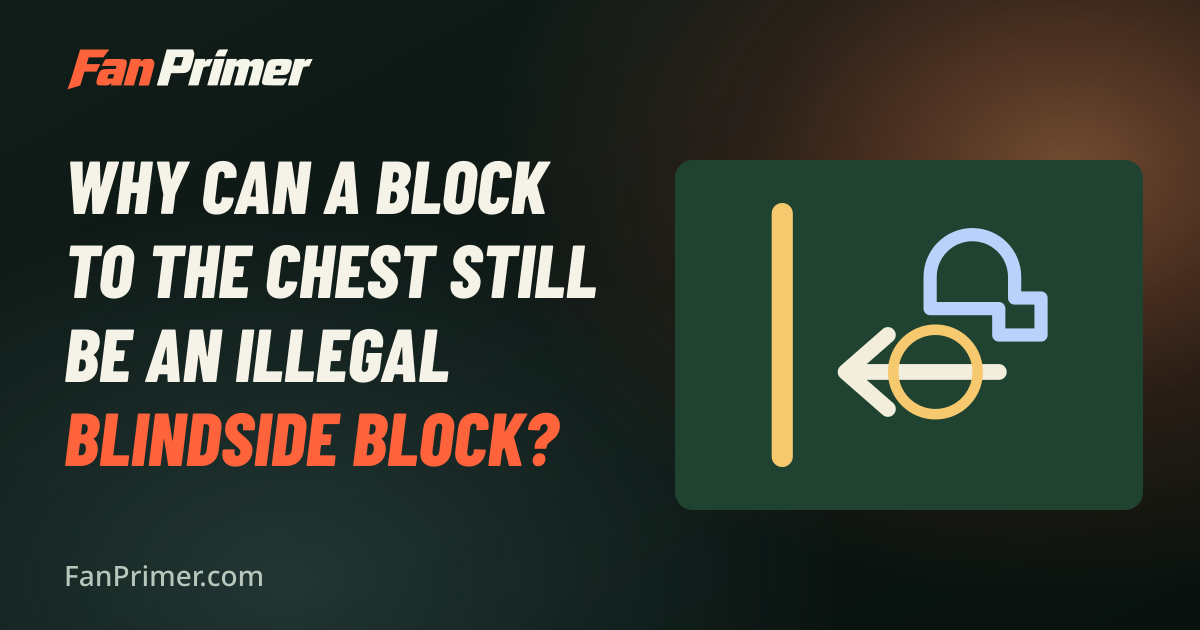
Cream B: blocker · Blue D: opponent · Gold: contact · Arrow: blocker’s travel
The opponent need not be hit in the back
Outside the exception, a blocker traveling toward or parallel to his own end line cannot deliver forceful contact with a helmet, forearm or shoulder. The target need not be the head or back. Here, the opponent faces the blocker and is hit in the chest, but the blocker’s direction and method still make it illegal.
Use the blocker’s own end of the field
A Foxes return blocker turns toward the end line his team defends and drives his shoulder into an Owl’s chest. Outside close-line play, that is the prohibited combination. Traveling sideways, parallel to that end line, can qualify too. Asking only whether the opponent saw the block misses this direction test.
Using the hands does not permit every block
The hand-contact picture removes the forceful helmet, forearm or shoulder blow in this rule. Holding, head strikes and blocks in the back can still be illegal. Likewise, traveling in another direction may avoid this particular test but still violate another rule.
The close-line exception is limited
Close-line play includes the offense’s pocket and 3 yards beyond the starting line. The area normally ends when the ball leaves it. The rule preserves it when the snap receiver retreats in the pocket immediately or after a slight delay, then hands off, passes, is tackled or runs on a designed play. This is not permission for every block near the old starting spot.
Other restrictions remain inside that area
Crackback and peel-back blocks have separate limits based on alignment, approach, location and contact. The close-line exception does not permit dangerous head contact or every low block. An accepted illegal blindside block costs 15 yards.