Downs & possession
How do downs and first downs work?
The takeaway
The team has up to 4 tries to reach its target. Short gains leave that target in place; reaching it earns fresh tries and a new target.
See how it works
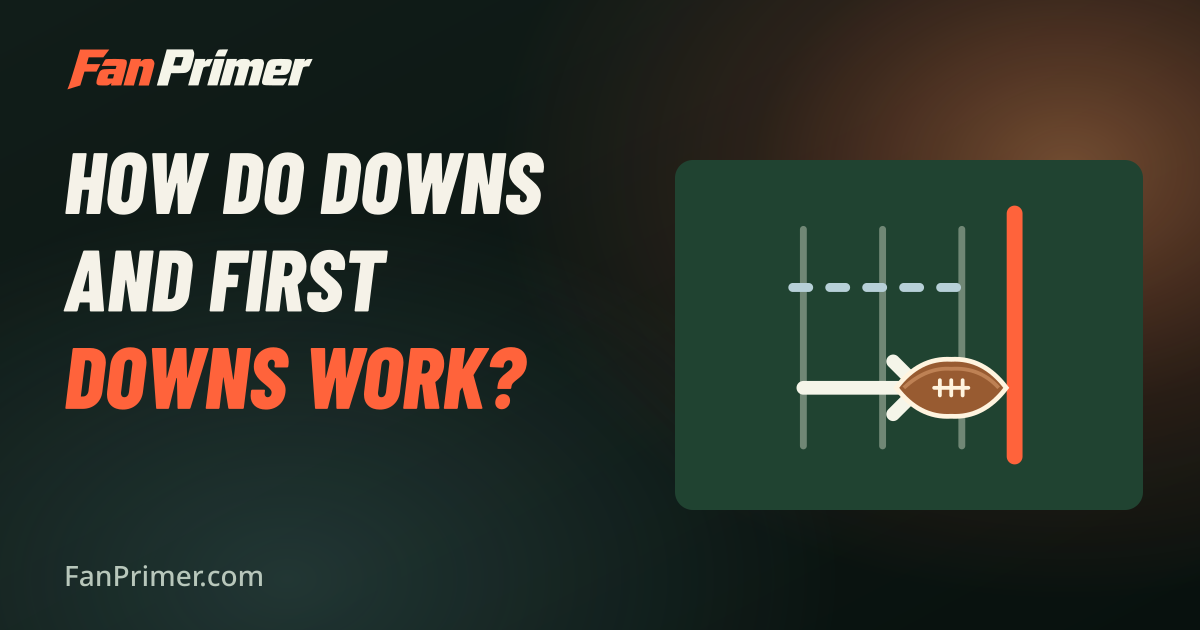
The ball starts at the 30; the target is the 40.
Dashed blue: this play’s start · Orange: first-down target
A down counts a try, not points
The team with the ball starts a set on 1st try. It normally has up to 4 tries to gain 10 yards from that starting position. The target stays at the same yard line while it tries. Advancing the ball can help the team score later, but gaining yards alone does not add points.
Add short gains toward the same line
The ball starts at the 30 and the target is the 40. A 4-yard run finishes at the 34. The next play is 2nd try, needing 6 yards. The orange target remains at the 40; it does not move 10 yards ahead after every play.
Reaching the target gives a new set
Next, a 7-yard gain takes the ball from the 34 to the 41. That passes the target and earns a first down. The new target is 10 yards beyond the actual finish, at the 51 in this field measurement. The team keeps the extra yard; officials do not move the ball back to the old target.
No gain or a loss still counts as a try
An incomplete pass from 2nd try with 6 needed normally leaves 3rd try with 6 needed. Losing 2 yards instead leaves 3rd try with 8 needed. The target stays where it was. On the 4th try, falling short gives the opponent the ball where play ended instead of another set for the same offense.
Near the end zone, aim for the goal
If the goal line is fewer than 10 yards away, it becomes the target for the new set. That is called goal-to-go: the team needs to score. Penalties, kicks and changes of possession bring other rules. This animation follows an ordinary possession near midfield.