Scoring & kicking
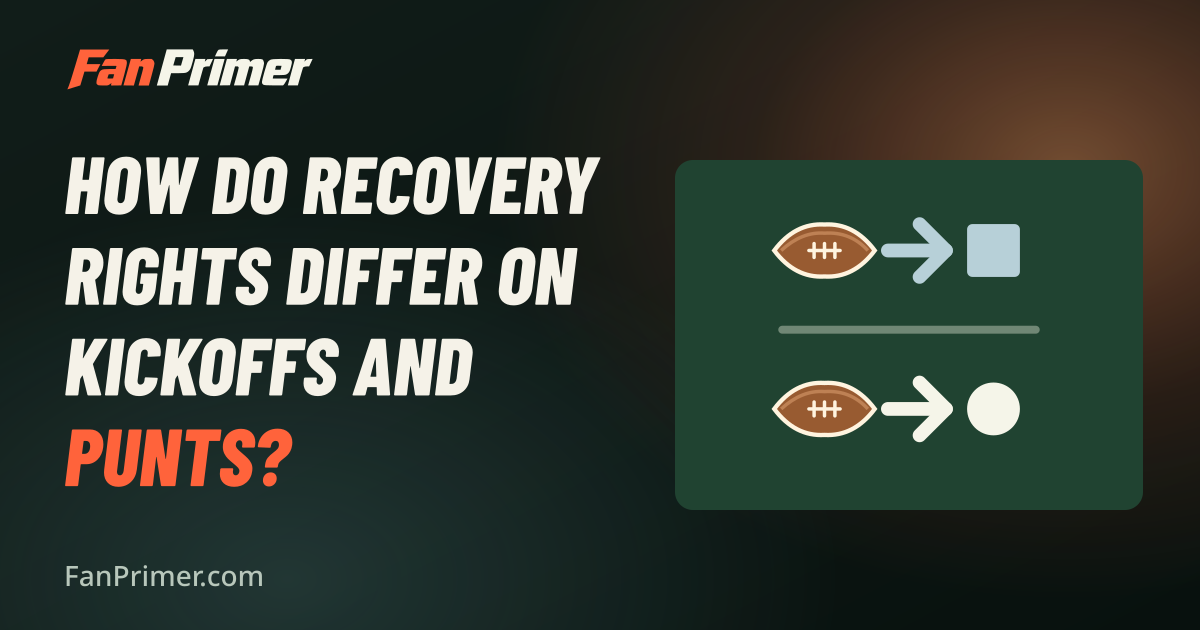
How do recovery rights differ on kickoffs and punts?
The takeaway
A kickoff bouncing in its landing zone can be recovered by the kickers. A punt bouncing downfield usually cannot be kept unless a receiver touched it first.
See how it works
Standard kickoff · no receiver touch
Kickers keep the recovery. The landing-zone bounce makes it recoverable; they cannot advance.
Punt · no receiver touch
Receivers get the ball. A bounce alone does not let the kickers keep a downfield recovery.
Punt · receiver touches first
Kickers keep the recovery. A downfield touch without possession makes the punt recoverable, but they cannot advance.
An ordinary kickoff can become recoverable on a bounce
The 2026 landing zone runs from the receiving 20-yard line to its goal line. Once the kick lands there, the kickers may recover it without a receiver touching it. A receiver’s touch in that zone or the end zone also opens that chance. A legal kicking-team recovery ends play and gives that team the ball there.
A punt bounce does not give the same permission
Beyond the starting line, a kicker picking up an untouched punt ends play and gives it to the receivers. A receiving player must first touch it beyond the line for the kickers to keep a downfield recovery. Even then, that pickup ends play; the kicker cannot run with it.
Touching and holding are different
A returner who touches a punt without controlling it has muffed it. The kickers cannot run with a downfield recovery of that kick. If he controls it first and then drops it, it becomes a fumble, and an opponent may ordinarily recover and run. Receivers can ordinarily advance a recovered kick unless a rule such as a fair-catch signal prevents it.
An onside kick has its own setup
In 2026, a team can declare an onside kick at any time, with the receivers notified. The kickers may recover once it reaches the receiving line, normally 10 yards away, or after an earlier receiver touch. That 10-yard test does not apply to an ordinary kickoff or a punt recovered downfield.
A blocked punt behind the line can still be run
The kickers may recover and run behind the starting line. Without a receiver touch beyond that line, the pickup alone does not earn new tries. On 4th down, the kicking team still needs to reach its original target.