Scoring & kicking
Which NFL score combinations are possible under the scoring rules?
The takeaway
Most whole-number scores can be built from legal scoring plays. Exactly 1 point is unusual: it requires a safety during the opponent’s extra attempt after a touchdown.
See how it works
Unusual totals can have valid paths
These are possible ways to build each score. A safety adds 2 points without needing a touchdown.
A 1-point safety still needs a touchdown
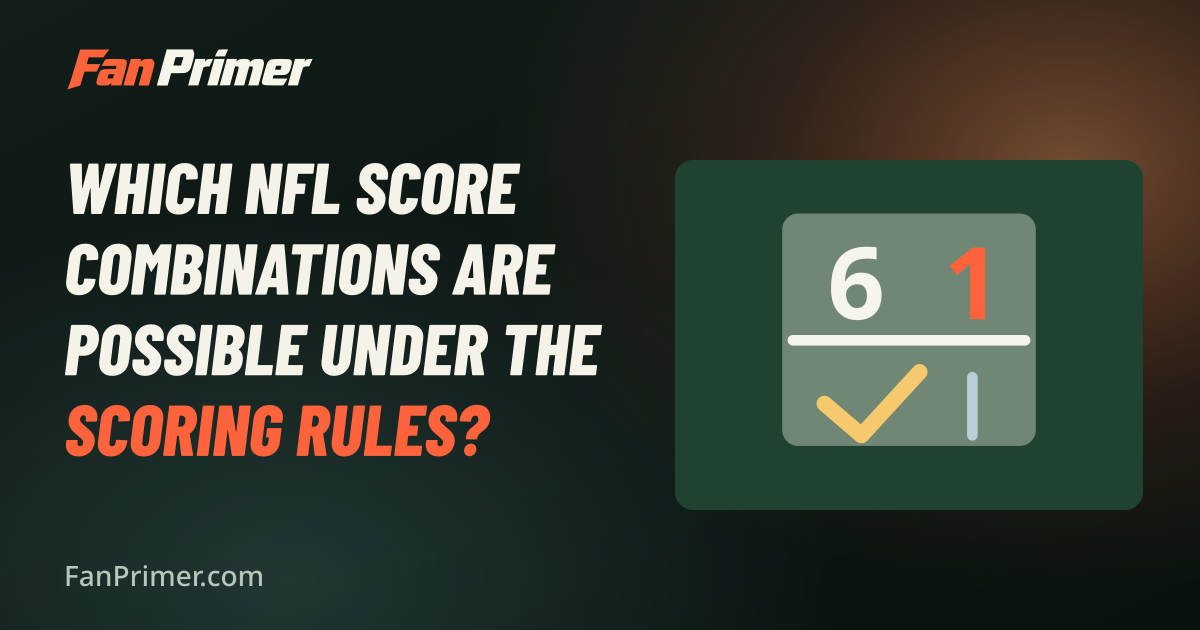
For 6–1, A scores a touchdown, then gives up a 1-point safety on the extra-point attempt. B’s point needs A’s touchdown first.
Scores list fictional Team A first, Team B second. These are complete scoring-event constructions, not a historical-results table or a claim about how likely the scores are.
Build scores from complete plays
A field goal adds 3, an ordinary safety 2, and a touchdown 6 before its extra attempt. That attempt can add 0, 1 or 2; a defensive touchdown on it earns 2. A safety and field goal can make 5–0. Two safeties per team can make 4–4. An unfamiliar score is not necessarily impossible.
Why 6–1 is possible but 7–1 is not
A safety on an extra attempt gives the opponent 1 point. Imagine A scores a touchdown, then takes the ball back into its own end zone during that try and is tackled. A has 6 and B has 1. A can add an ordinary 2 or 3 to reach 8–1 or 9–1. It has no stand-alone 1-point scoring play to make 7–1: an extra-point kick would need another touchdown first.
A short test for the two totals
In this model of completed scoring events, any pair of nonnegative whole-number totals is constructible if neither total is 1. Totals from 2 up can be built from 2s and 3s; 0 needs no score. If one team has exactly 1, the other must have 6 or at least 8. A 1 against 0, 1, 2, 3, 4, 5 or 7 has no construction. Reversing the teams changes nothing.
Possible does not mean it has happened
The test concerns scoring arithmetic, not game history or enough time to create the result. A scoreboard between a touchdown and its try can be temporary. Omitting an unnecessary end-of-game try can leave 6, but creates no free point. An administrative forfeit is recorded as 2–0 separately from played scoring. Overtime endings and historical score records need their own checks.