Penalties & rulings
What is an illegal crackback block?
The takeaway
A blocker coming inward from certain wide or moving positions cannot hit low or use prohibited contact on a protected opponent near the starting line.
See how it works
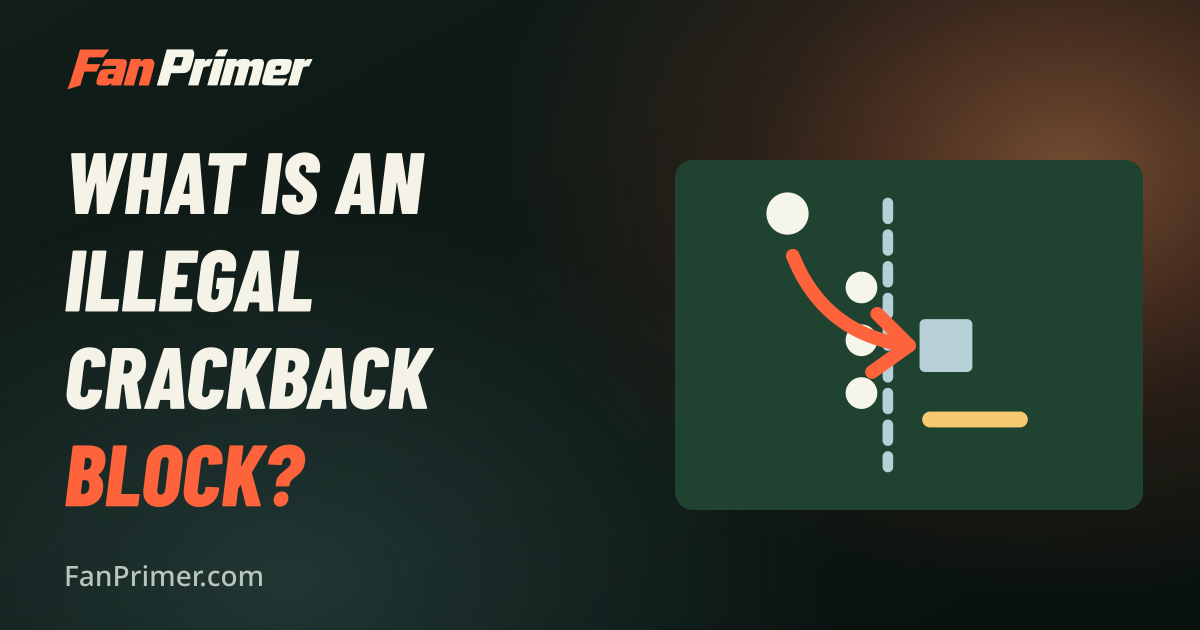
The blocker starts wide and comes inward
At the snap, the set blocker is 3 yards outside the tackle. He moves toward the original snap position and contacts a defender 1 yard beyond the starting line.
The first contact is below the waist
The same blocker contacts the grounded defender’s thigh first. That low contact makes this a prohibited crackback block, even near the original line.
Cream: offense · Blue: defense · Dashed blue line: starting line · Gold arrow: inward approach · Dashed white line in close-up: waist · Gold ring: low contact.
The name describes more than a surprise hit
A crackback block brings an offensive player toward the position where the ball was snapped. The rule applies to specified starting positions and to contact within 5 yards on either side of the starting line. A block is not automatically illegal simply because a receiver comes inward or an opponent did not see him.
Check where the blocker began
One qualifying setup is a stationary offensive player more than 2 yards outside an offensive tackle when the ball is snapped. The rule also covers a backfield player who later moves more than 2 yards outside the tackle, and a backfield player in motion at the snap. In our example, the set blocker begins 3 yards outside the tackle.
Then check the approach and first contact
He moves inward toward the original snap position and hits a grounded defender’s thigh 1 yard beyond the starting line. That combines the qualifying alignment, direction, nearby location and prohibited low contact. Contact below the waist is forbidden here even within close-line play; being near the linemen does not create an exception.
High contact is not automatically safe either
A crackback recipient also has defenseless-player protection. Prohibited forcible head or neck contact and other listed dangerous contact can make the block illegal without a low hit. Other rules, including blindside and peel-back restrictions, can apply independently. Do not use waist height as the only test.
The accepted penalty is 15 yards
An illegal crackback block costs 15 yards. It is distinct from a chop block, which involves a high-low combination of offensive blockers against the same defender. Our example has one blocker; its illegality comes from the crackback conditions and low contact.