Penalties & rulings
When does a hard tackle become unnecessary roughness?
The takeaway
A hard hit is not automatically a foul. Unnecessary roughness punishes prohibited contact, including needless hits after a runner is out, down or stopped.
See how it works
Runner still inside
The runner remains inbounds and can still advance. Ordinary legal tackling is permitted; dangerous techniques remain prohibited.
Runner clearly outside
The runner has crossed the white boundary. A new, needless hit now can be unnecessary roughness.
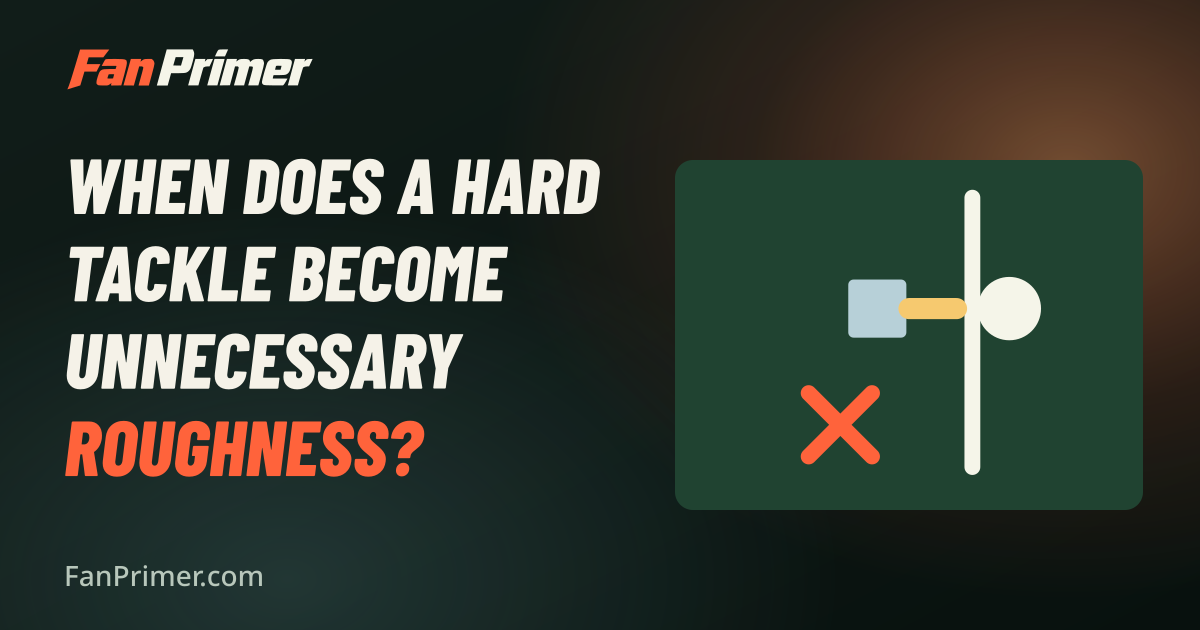
Cream R: runner · Blue D: defender · White line: sideline; the white boundary is out of bounds.
The question is what contact was allowed
Football permits forceful legal tackles of a runner who is still advancing. A dramatic collision or a player falling does not, by itself, establish unnecessary roughness. Officials consider the runner’s status, the timing of the contact and the action the opponent used.
A runner can lose the need to be tackled
A runner who has clearly stepped out, slid, taken a knee or had his forward progress stopped is no longer an ordinary advancing target. Diving onto a player on the ground, throwing a runner down after the ball is dead or aggressively pulling someone off a pile can also be prohibited.
The sideline example turns on a new hit
In the second picture, the runner is clearly outside before the defender begins a needless new hit. That differs from a legal tackle already underway inside that carries both players across the boundary. Defenders must make an effort to avoid contact when the runner goes out.
The ordinary cost is 15 yards
Unnecessary roughness carries a 15-yard penalty, with an automatic first down when the defense commits it. For example, a separate defensive late hit after a runner is down at his own 35 can move the ball to midfield and give the offense a fresh set. Near a goal line or with other fouls, enforcement can differ. Flagrant conduct can also lead to ejection.
Other dangerous actions have their own rules
A hit can be illegal even before the runner goes down or out. Rules also address helmet use, defenseless players, horse-collar tackles and other techniques. Unnecessary roughness is not a rule saying that every tackle is legal until the whistle.