Penalties & rulings
What is holding, and what blocking is legal?
The takeaway
Holding is illegal restraint that changes an opponent’s movement. Blocking allows contact, but a grab, hook or pull that prevents escape can become a foul.
See how it works
Same block. Different finish.
Release: legal block
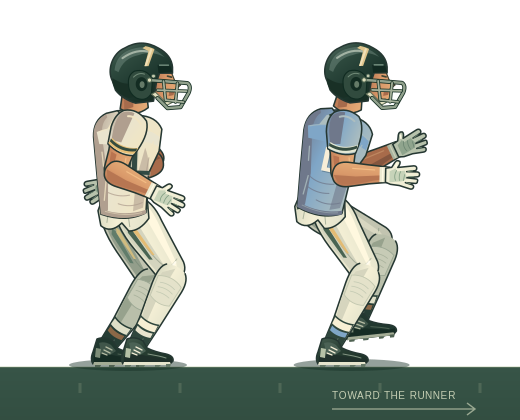
Jersey pull: holding
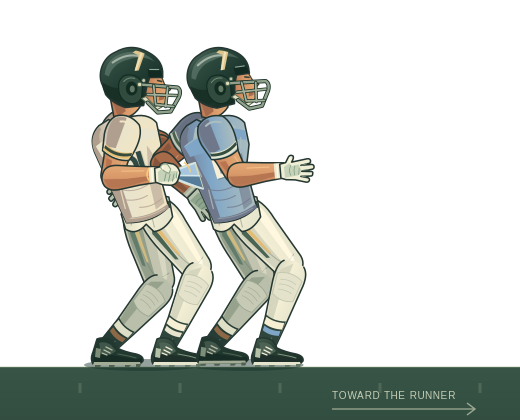
One blocker releases. The other pulls the jersey and checks pursuit.
Inspect the hands
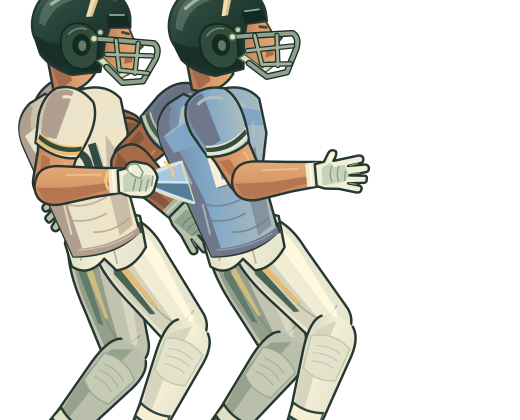
Watch the movement the defender loses
A blocker wants to keep a defender away from the runner or quarterback. He can use legal contact and footwork to stay in the way. In the holding comparison, the defender tries to move past, but a jersey grip pulls him back and restricts his pursuit. That lost freedom to move is the important difference.
Hand position alone does not settle the call
Hands inside a defender’s body frame can still hold. Hands outside do not automatically prove holding either, although a blocker must work to bring them inside. Officials judge whether the hands or arms materially restrict the defender’s path or pursuit, not just where a hand appears in one frozen image.
An ordinary offensive hold costs 10 yards
Suppose a pass play begins at the offense’s own 30 on 1st try, needing 10 yards. An ordinary accepted offensive hold measured from that starting spot moves the ball to the 20: still 1st try, now needing 20 yards. A run can use a different measuring point; do not always subtract 10 from where the runner stopped.
The defense can hold too
A defender may legally fight through a blocker to reach the runner. Illegally grabbing an eligible receiver away from the ball is different. Ordinary defensive holding costs 5 yards and awards an automatic first down, even if those 5 yards do not reach the offense’s old target.
Some apparent holds have specific exceptions
A defender’s upward rip move can put a blocker’s arm in a position that looks illegal without the ordinary holding call; taking away the defender’s feet can change that exception. The rule also treats action away from the point of attack differently. A replay angle showing a grip is useful evidence, but it is not the complete rule test.