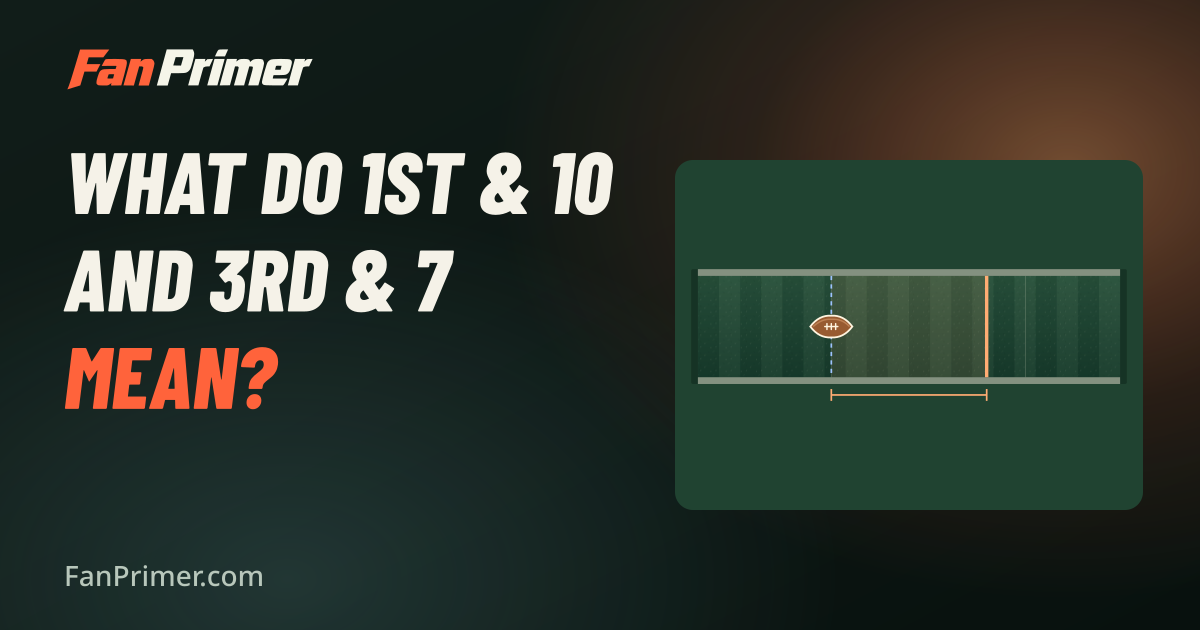
Four tries to gain 10 yards
A down is one chance to run a play. The team with the ball gets up to four downs to move 10 yards forward. Reach that distance and it earns four new chances.
The target stays put until you reach it
1st & 10
- Ball at
- Own 20
- Last play gained
- —
- Yards still needed
- 10 yd
“1st & 10” means first chance, 10 yards to go. Start at your own 20-yard line. The target is the 30.
| Play result | Ball at | Target | Next down |
|---|---|---|---|
| 1: +3 yards | Own 23 | 30 | 2nd & 7 |
| 2: +8 yards | Own 31 | 30 → 41 | 1st & 10 |
You can reach the target on any of the four plays. If the play ends at or beyond it, you earn four new chances. You do not need to use all four.
Read the visual, step by step
- 1st & 10. “1st & 10” means first chance, 10 yards to go. Start at your own 20-yard line. The target is the 30.
- 2nd & 7. The first play moves the ball 3 yards, to the 23. “2nd & 7” means second chance, 7 yards still needed to reach the 30.
- First down earned. The next play gains 8 yards and ends at the 31, beyond the target. You keep all those yards—and earn a new first down, a fresh set of four chances.
- 1st & 10. Start again at the 31 with four chances to gain 10 more yards. The new target is the 41. A first down gives you more chances, not points.
What if the play does not move you forward?
An incomplete pass uses one chance but puts the ball back where that play started. Losing yards leaves more distance to the same target. Still short after your fourth chance? The other team gets the ball.
Near the end zone: ‘and goal’
If a new set of four chances starts less than 10 yards from the end zone, the goal line is the target. “1st & goal” means first chance to reach that goal line and score a touchdown.
Optional
Try a different result
It is your third chance. From your own 24-yard line, you need 6 yards to reach the 30. You run 8 yards, to the 32. What comes next?
See the explanation
You passed the target, so you earn four new chances. Keep all 8 yards: start at the 32 and measure 10 more to the 42. That is 1st & 10.
These explanations use NFL rules unless a lesson says otherwise. Examples are simplified; rules and interpretations can change, and other competitions may differ.
Sources & the scope of these diagrams
Ordinary plays without penalties or a possession change during the play. Positions are measured from the offense’s own goal line. The cropped field uses accurate yard spacing; field width and ball size are illustrative. A new goal-to-go series targets the goal line. The penalty note introduces possible effects only; the illustrated plays themselves have no penalties.
- NFL 2026 Rulebook · Rule 3 §8, Rule 7 §3 and Rule 8 §1 Article 4
- NFL 2026 Rulebook · Rule 14: penalty enforcement
- NFL Football Operations · Football Terms: fouls and penalties
Source edition checked 2026-10-12 · Original Fan Primer diagrams.