How football teams score points
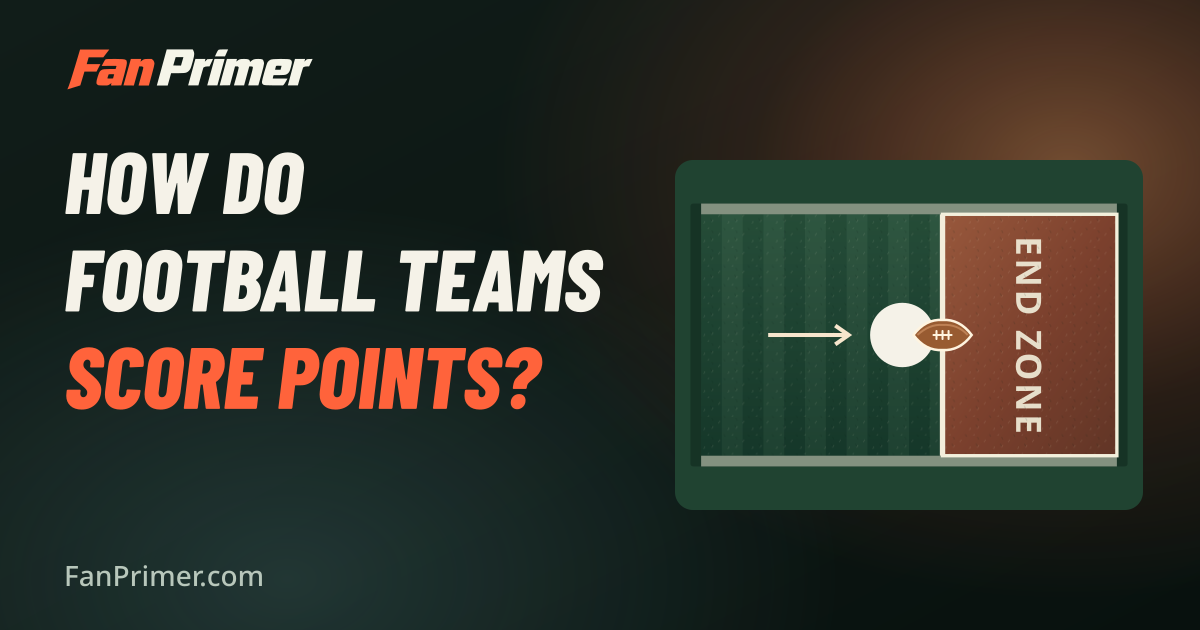
A touchdown scores 6 points. Afterward, the team gets one extra play to try for 1 or 2 more. A field goal—a different kind of scoring kick—earns 3 points.
Score 6, then try for extra points
One extra play: choose a kick or a run/pass
The touchdown took Owls from 10 to 16 points. Now they choose how to try for more. This extra play is called a try.
If the extra play fails, it adds no points. Owls keep the 16 they already earned.
A player can also score by completing a catch in the end zone. For a touchdown, the ball does not have to touch the ground.
Read the scoring action
- Before Owls have 10 points. Their runner carries the ball toward the goal line ahead, staying inside the field’s boundaries.
- Goal line · +6 The runner still holds the ball and stays inside the field. As the ball’s front tip reaches the goal line, Owls score 6 points.
Why one kick is worth 3 and another is worth 1
The ball must go between the two tall posts and over the horizontal bar. The points depend on when the team kicks it.
Instead of trying for a touchdown
Field goal
A team can choose this scoring kick during its turn with the ball. A field goal has no extra-point play afterward.
After the touchdown
Extra-point kick
The touchdown’s 6 points were already added.
Foxes remain at 14 in both examples. A missed kick adds no points.
Read the scoring action
- Before the kick The kick is on its way. No points have been earned in either example yet.
- Through the goal The whole ball goes between the posts and over the bar. A field goal adds 3 points. A kick on the extra play after a touchdown adds 1.
After a field goal or the extra play after a touchdown, the scoring team normally kicks the ball to the other team. That play is a kickoff.
A less common score: the safety
Separate example · before this play: Owls 10, Foxes 14.
2 points to the other team
Owls’ runner retreats with the ball into Owls’ own end zone and is tackled there. Foxes get the points.
Owls stay at 10.
A defender can score 6 tooA defender can catch the other team’s pass or pick up a ball an opponent lost. Carrying it to the opposite end zone for a touchdown earns 6 points, too.
Progress alone earns 0Moving forward or earning a first down adds no points. It gives the team more room or more chances to reach a scoring play.
Optional · recognize the scoring play
Owls have 8. They score a touchdown, then miss the kick on the next play. What is their score?
See the explanation
14 points: the 8 they had, plus 6 for the touchdown. The missed extra-point kick adds nothing.
These explanations use NFL rules unless a lesson says otherwise. Examples are simplified; rules and interpretations can change, and other competitions may differ.
Sources & the scope of these diagrams
Ordinary NFL scoring examples: runner and receiving touchdowns, a field goal, a separate post-touchdown try, a defensive return touchdown and a safety after a runner retreats into his own end zone. Close views show only relevant players; field width, player size and kicking distance are illustrative. Completed-catch requirements, missed-field-goal possession, defensive try scoring, unusual safety exceptions and late-game exceptions are outside this chapter.
Explore scoring in more detail
- NFL Football Operations · 2026 Rulebook, Rule 11 §§1–5: scores, touchdown, try, field goal and safety
- NFL · Official 2026 playing rules, Rule 11 (PDF pages 49–51)
Source edition checked 2026-10-14 · Original Fan Primer diagrams.