Player roles and how a play works
Each team has 11 players on the field. Follow the ball first; learn the players’ jobs as you go.
Who lines up where?
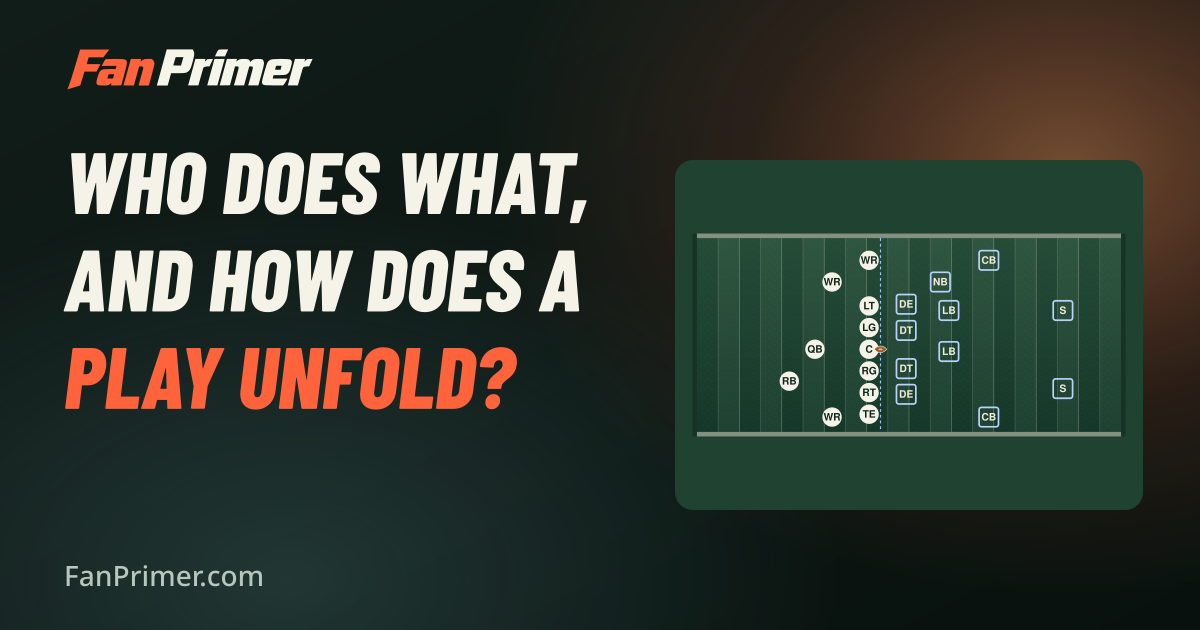
The line of scrimmage is the imaginary starting line through the ball. The teams line up on opposite sides.
Offense
Defense
How the players help each other
Blockers keep opponents away from a teammate. Other players carry the ball or get ready to catch it. Defenders try to tackle the player with the ball: bring that player to the ground.
A play starts with the snap: the center sends the ball backward between their legs. Then follow the player with the ball.
Read every role’s job
Offense
- QB: Quarterback
- Receives the snap to start most plays. Can throw the ball, hand it to a teammate, or run with it.
- In this lineup, the quarterback stands behind the middle of the offensive line.
- RB: Running back
- Often takes the ball directly from the quarterback. This exchange is a handoff. Then the running back runs with it, looking for room between defenders.
- The running back starts behind the quarterback, ready to receive the ball directly from the quarterback’s hands.
- WR: Wide receiver
- Finds space to catch a pass. Can keep running after the catch.
- Three wide receivers are spread away from the five offensive linemen.
- TE: Tight end
- Can block opponents or catch passes. Often starts beside the five players in the offensive line.
- The tight end lines up beside the offensive line.
- OL: Offensive line
- Five blockers give a runner room or a passer time. The middle player, the center, also sends the ball backward to start the play.
- Five offensive linemen stand together on the starting line. The center is in the middle.
Defense
- DL: Defensive line
- Faces the offensive line. Tries to stop the runner or reach the quarterback before the ball is thrown.
- Four defensive linemen face the offensive blockers.
- LB: Linebacker
- Starts behind the defensive line. Can tackle runners, stay near players who might catch a pass, or chase the quarterback.
- Three linebackers start behind the defensive line.
- CB: Cornerback
- Usually starts near a wide receiver. Tries to stop that player from catching a pass.
- Two cornerbacks line up near the receivers toward the sides.
- S: Safety
- Starts farther back to help stop long passes and runners who get past the other defenders.
- Two safeties start farther back, nearer the end zone they defend.
Follow the ball through a play
Run
Before the play starts
The quarterback and running back wait behind the five offensive linemen. The center has the ball.
The defensive line faces the blockers. The other defenders watch for where the ball will go.
Dashed blue line: where this play starts.
Completed pass
Before the play starts
Now watch a separate example with the same players: a pass that is caught.
The setup alone does not reveal whether the offense will run or pass.
Dashed blue line: where this play starts.
If a legal forward pass hits the ground before anyone catches it, it is incomplete. That play is over. The next play starts where the pass play began.
See the snap and handoff up close
Snap
The center sends the ball backward between the legs to the quarterback.
Handoff
The quarterback places the ball into the running back’s arms.
Read both plays, step by step
Run
- Before the play starts
The quarterback and running back wait behind the five offensive linemen. The center has the ball.
The defensive line faces the blockers. The other defenders watch for where the ball will go.
- The center sends the ball to the quarterback
This backward exchange is the snap. It starts the play, and both teams begin moving.
The offensive line blocks the defenders. The running back moves toward the quarterback.
- The quarterback hands the ball to the running back
This direct exchange is a handoff. The offensive line and tight end try to make room for the runner.
The defensive line tries to close that opening. The linebackers move toward the runner.
- The running back runs through the opening
The running back carries the ball forward. The receivers can block opponents, too.
The linebackers and defenders farther back move toward the runner.
- Where the next play starts
A defender brings the running back to the ground. That tackle ends this play.
The teams will line up again at the final ball position.
The offense and defense will begin the next play from the new spot.
Completed pass
- Before the play starts
Now watch a separate example with the same players: a pass that is caught.
The setup alone does not reveal whether the offense will run or pass.
- The quarterback receives the ball
The snap starts the play. The quarterback steps back, and the receivers follow planned paths to find space. These paths are called routes.
The offensive line protects the quarterback. Defenders try to reach the quarterback or stay near possible receivers.
- The quarterback throws to a wide receiver
The football is in the air. The line is still protecting the passer.
Defenders try to stop the catch. They can also try to catch the pass themselves.
- The receiver catches it and keeps going
Catching the pass does not end the play. The wide receiver can now run farther with the ball.
The cornerback and defenders farther back move toward the receiver.
- Where the next play starts
After the catch, the receiver carries the ball forward. A tackle ends this play.
The teams will line up again at the final ball position, beyond the catch point.
The offense keeps the yards gained after the catch.
Optional
A receiver catches a pass, runs farther, then is tackled. Which spot becomes the next starting line?
See the explanation
Catching the pass does not end the play. The receiver can keep gaining yards until stopped. The next play starts at the final ball position.
These explanations use NFL rules unless a lesson says otherwise. Examples are simplified; rules and interpretations can change, and other competitions may differ.
Sources & the scope of these diagrams
Six chapters introducing ordinary NFL play. Diagrams use original, simplified examples, not tactical prescriptions. Field width, player size and movement are illustrative. Examples omit penalties and rare exceptions unless stated. The game timeline concerns regular-season and postseason games; preseason games can end tied. Detailed overtime, clock, kicking, catch and penalty rules belong in separate topics.
- NFL 2026 Rulebook · Rules 1, 3 §20, 4, 5, 7, 8 and 11 §2
- NFL Football Operations · Formations
- NFL Football Operations · Football Terms: player positions
Source edition checked 2026-10-12 · Original Fan Primer diagrams.