Foundations
What is the line of scrimmage?
The takeaway
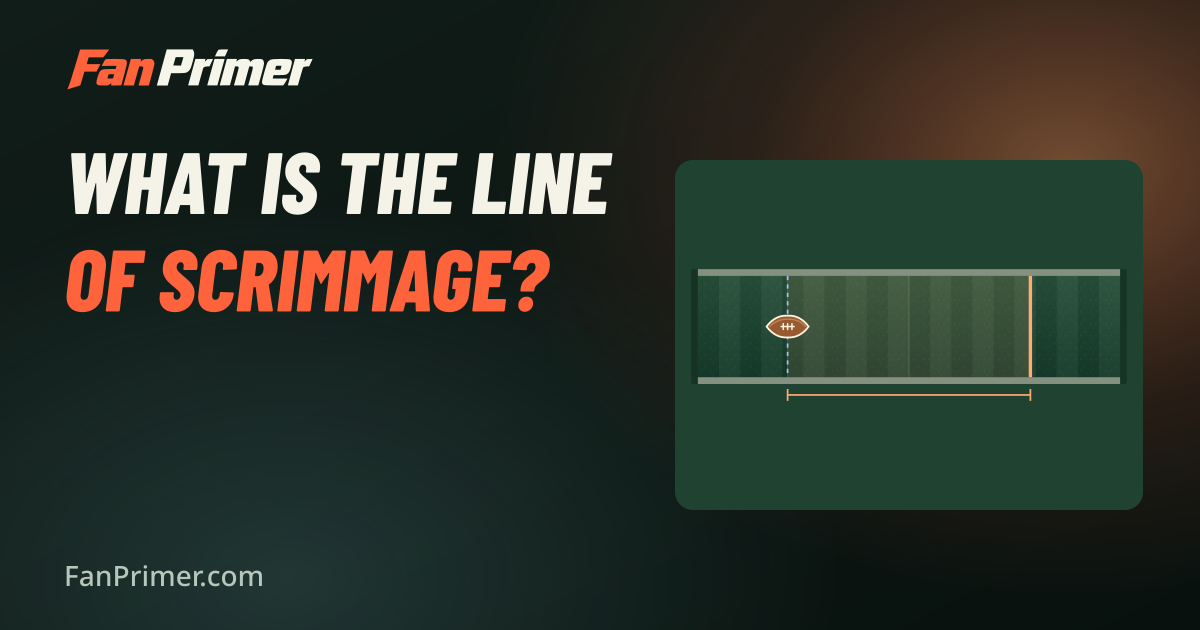
The line of scrimmage marks where a play starts. Find the ball before the play: that is where the starting line crosses the field.
See how it works
Before the gain
Starting line: 30. First-down target: 40. 10 yards to go.
After a 3-yard gain
Next starting line: 33. Same target: 40. 7 yards to go.
Dashed blue: starting line · Solid orange: first-down target
The snap travels backward
The center sends the ball back to the quarterback, away from the attacking direction.
Find the ball before the action begins
Before an ordinary play, the football rests on the ground. Its position sets the starting line across the field. The center, a blocker in the middle, sends the ball backward to start the play, usually to the quarterback. That backward start is the snap. A kickoff starts differently, with a kick.
The starting line moves; the target may stay
Here the ball starts at the 30-yard line and the target is the 40. After a 3-yard gain, the next play starts at the 33. The target stays at the 40, so 7 yards remain. Blue and yellow lines added by a TV broadcast are graphics, not lines painted on the grass.
The line also matters for penalties
Players must follow rules about where to stand and when to move before the snap. An offensive false start can stop play before it begins. The starting line also determines where a legal forward pass may begin.
There is a small gap between the teams
Strictly, each team has a starting line through its end of the football. The space between those lines is one ball-length wide and is called the neutral zone. The center handles the ball; the other players must follow the alignment and movement rules around that gap.