Foundations
How does American football work?
Follow the ball, learn what each try needs, and see how teams score.
The takeaway
The team with the ball tries to move toward the other team’s end zone and score. It earns more tries by gaining enough yards.
Find the team with the ball
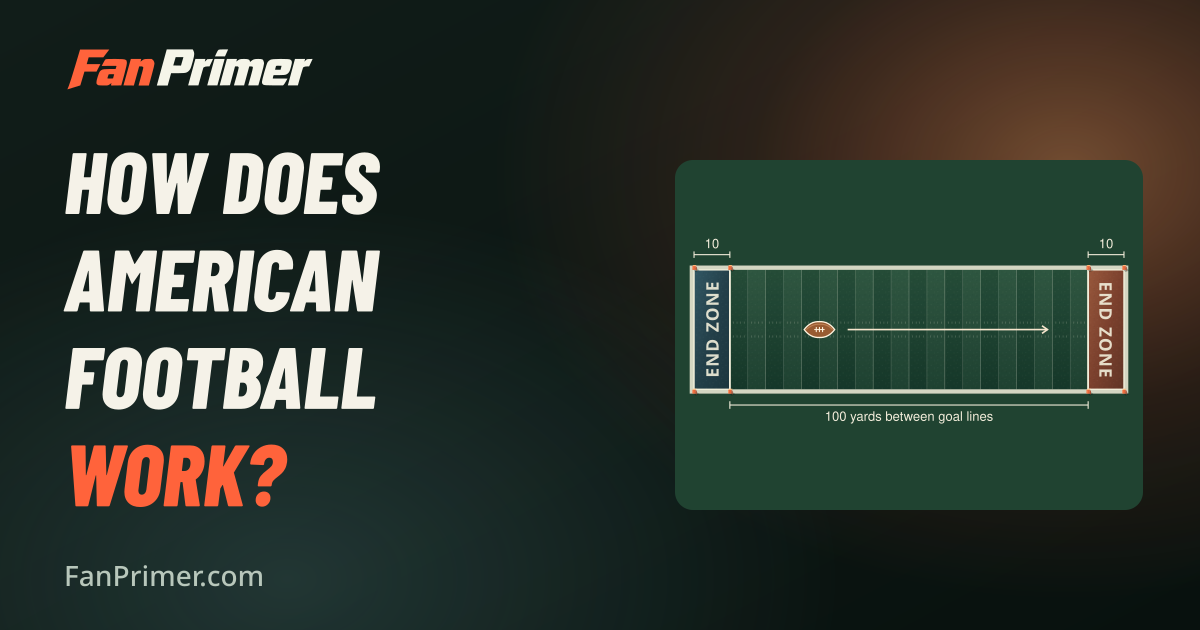
The offense attacks right · Each end zone is 10 yards deep
The team with more points at the end wins. Each side has 11 players on the field. The team with the ball is the offense; the other is the defense. The offense tries to reach the opponent’s end zone, while the defense tries to stop it and get the ball.
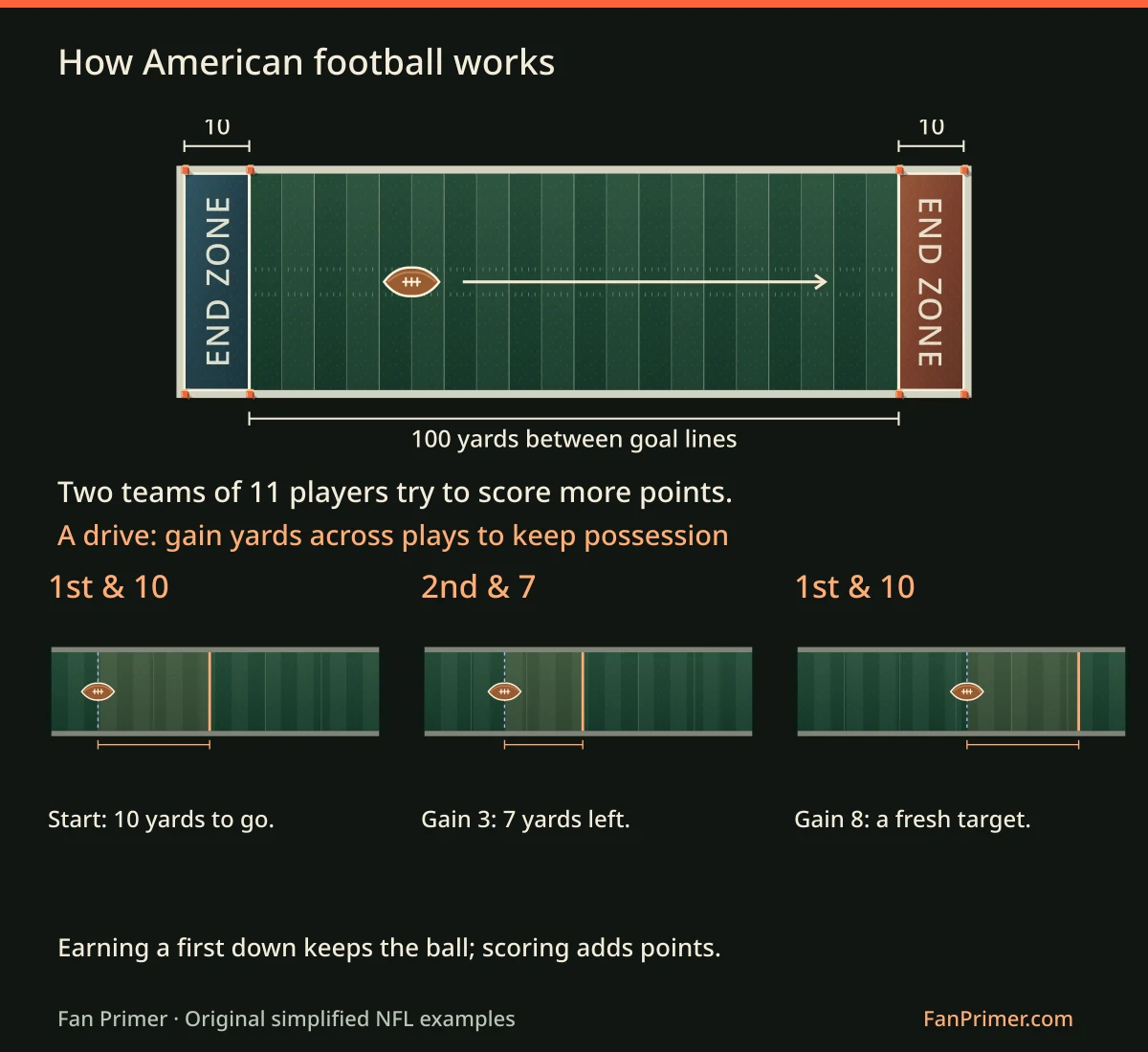
The field has 100 yards between the goal lines and a 10-yard end zone at each end. Before an ordinary play, find the football. The center starts the play by sending it backward, usually to the quarterback. That action is called the snap.
Each snap starts one play
Send the ball backward.
Run forward with it.
Tackled after 3 yards.
One play. One try used. Line up again at the new spot.
The quarterback can give the ball to a runner, throw it or run with it. Here, the runner gains 3 yards before a tackle stops him.
Officials place the ball where the next play will begin, and players line up again. A series of plays while one team has the ball is called a drive. The pauses separate the short bursts of action.
Gain 10 yards to earn more tries
1st & 10
Ball at 25; target at 35. 10 yards to the same target.
2nd & 7 · +3 yards
Ball at 28; target at 35. 7 yards to the same target.
1st & 10 · +8 yards
Ball at 36; target at 46. 10 yards to the new target after a fresh set.
The offense normally gets up to 4 plays, called downs, to gain 10 yards. Gains can add up across those tries. The target stays in place until the offense reaches it.
Here, a 3-yard gain on the first try leaves 7 yards. An 8-yard gain on the second passes the target. That earns a first down: a fresh set of 4 tries, with a new target 10 yards ahead. It does not score points.
See how possession ends
Touchdown versus field goal
Touchdown · 6 points
A runner possesses the ball as it reaches the opponent’s goal line. A completed end-zone catch can also score.
Field goal · 3 points
The entire kicked ball goes above the crossbar and between the uprights.
A touchdown scores 6 points when a runner holding the ball reaches across the opponent’s goal line or a receiver completes a legal catch in the end zone. A field goal scores 3 by kicking through the goalposts. A first down instead lets the same team keep trying to score.
On the fourth try, falling short on an ordinary run or pass gives the opponent the ball there. Punting is kicking the ball away to make the opponent start farther back. A team may choose that trade instead of risking a failed fourth try.
Read what the next play needs
Example TV display · 2nd play in our sequence
Next-play question: can Away gain 7 yards and keep this possession going?
The TV label gives the try number and yards still needed for a fresh set. Here, Away has 7 points and also needs 7 yards. Those matching numbers measure different things.
An ordinary game has 4 quarters of 15 minutes, with halftime after the second. Stoppages make the broadcast longer. A separate play clock limits the wait before the next snap. A tied game goes to overtime; in the regular season, overtime can still end tied.
Save the illustrated explanation